Showing posts with label Activism. Show all posts

Thursday, February 2, 2017

In West Philly, activists train to 'disrupt' deportations

http://www.philly.com/philly/news/In-West-Philly-activists-train-to-disrupt-deportations.html

A few dozen people marched across the warehouse floor, holding cardboard signs and singing in Spanish. “Stop the raids,” the signs read.
They were stopped halfway across the room. “You can watch,” said a man in the middle of the room, “but you can’t come any closer.” The group locked arms and sat on the floor. The man pulled at their arms and tried to drag them apart. The room echoed with shouts and singing.
Peter Pedemonti clapped his hands. “OK, let’s take a breath,” he said. The signs lowered, the line broke apart, and the 50 or so people who had gathered in the warehouse Saturday afternoon turned expectantly toward him.
They were here to learn how to disrupt a deportation. It was something that Pedemonti’s interfaith immigrant rights group, the New Sanctuary Movement, had been planning for months, ever since President Barack Obama’s administration announced a round of deportation raids, mainly targeting undocumented Central American adults and children. At the time, officials had said they would try not to conduct raids at schools, hospitals, or places of worship.
“But if Immigrations and Customs Enforcement comes to your house, you can’t leave to find sanctuary in a church or a congregation,” Pedemonti said. “So we thought: We’ll bring the congregation to you.”
The idea was to set up a hotline that immigrants could call if ICE agents showed up at their door – and to show up at deportations themselves, with a few dozen activists and a ready-made prayer service. Some would sing and pray and read Scripture; others would form a line and block the sidewalk, risking arrest. About 60 people signed up for the program, called “Sanctuary on the Streets.” But they were never called to a deportation, and considered scrapping the program.
Then President Trump was elected, with his promises to crack down on illegal immigration and on sanctuary cities like Philadelphia, which does not cooperate with federal officials’ detainer requests for undocumented immigrants charged with nonviolent crimes. New Sanctuary Movement sent an email to its mailing list, asking again for volunteers for Sanctuary on the Streets. This time, 1,000 people responded.
Pedemonti has been holding training sessions for the program twice a month since. The executive orders Trump signed last week -- which aim to withhold federal funding from sanctuary cities, hire 10,000 new ICE agents, build a border wall, and suspend the U.S.’s refugee program for four months -- have lent the program a new urgency, attendees said.
“I just want to help,” said Daoud Steele, a carpenter from West Philadelphia who was raised Muslim and said he knew Syrian refugees affected by one of the orders. “[Immigrants today] are no less American than my great-great-grandparents, who came from the Netherlands. Everyone here is an immigrant.”
So he and several dozen others came to a cavernous room in the warehouse in West Philadelphia on Saturday. Maria Turcios, a New Sanctuary member originally from Honduras, told the group about how immigration officials had come to her house in 2004, searching for the father of one of her grandchildren, who was not at home. The agents left with three of her family members, she said. Four years later, her daughter was served a deportation order. The family considered asking her to leave, she said, but ultimately decided to fight the case in court. They won.
“The more than 1,000 people who signed up for Sanctuary in the Streets will make history together,” she said through an interpreter. “Showing up today is an act of love.”
Attendees split into groups and spent the afternoon acting out a Sanctuary in the Streets protest, with different groups playing deportees, ICE agents, and protesters.
Pedemonti told them how to approach a house that was being raided (slowly and deliberately), how to identify themselves to ICE agents outside (politely but firmly), and how to begin a prayer service on the sidewalk (loudly but reverently). Afterward, he said, staff members from New Sanctuary would remain to comfort family members left behind.
“This is a nonviolent action – we show up with love and compassion,” he told the group. “If an ICE agent tells you to stop, you’re going to stop. If they tell you to move back, you’re going to move back.”
Others in a protest group can choose to risk arrest – sitting down on the sidewalk to block ICE agents, or surrounding the agents’ vehicles, he said. Those volunteers will receive special civil-disobedience training.
“Is the goal to actually stop the raid – for real?” Steele asked.
“If ICE is going to take the family, we’re not going to stop them,” Pedemonti said. The aim is not to try to break a line of agents, or to resist arrest, he said. “But we want to put public pressure on them. To tell them, every time they show up at a house or a workplace, we’re going to be there.”
Pedemonti said he wanted ICE and the authorities to know of the New Sanctuary Movement's plan. In turn, he wants the group to try to work to understand immigration authorities – “to see their humanity.” Those who criticize the notion of protesting a deportation, he encourages to read Scripture – specifically, Matthew 25:35: “For I was a stranger, and you welcomed me.”The organization wants to continue to publicize the hotline and train new volunteers, Pedemonti said. “In this moment, it’s important for people who are affected [by the executive orders] and people who aren’t to stand up, and people who aren’t affected have to start taking risks,” he said.
Afterward, Crystal Gonzalez, an arts administrator from West Philadelphia, said she was ready take those risks. She said she had signed up for the program before the election, alarmed by the record-setting number of deportations under the Obama administration. Her parents immigrated from Cuba before she was born, she said, and benefited from programs that helped immigrants fleeing communist countries.
"My family's status here was never questioned," she said. "So it's about solidarity, and really, truly feeling the concept of 'Your problem is my problem.' I can utilize the privilege and support my family received."

Monday, January 30, 2017

Neo-Nazi Richard Spencer Got Punched—You Can Thank the Black Bloc

The sky was gray, a light snow fell, and the weather was bitingly cold. But the mood outside New York’s John F. Kennedy Airport (JFK) on Saturday was red-hot with anger, as dozens, and then hundreds, and then, as night fell, thousands arrived to protest President Donald Trump’s executive orderbarring entry into the United States of all refugees—including Syrian refugees, perhaps indefinitely—as well as visa-holders from seven Muslim-majority countries.
The rally, organized by a coalition of groups including the New York Immigration Coalition, the Arab American Association of New York, and Make the Road New York, came together within hours. The call for a rapid-response demonstration was posted on Facebook in the morning, and word quickly spread on social media. Supporters of these groups came from across New York, traveling long distances on the subway to reach an airport not easily accessible for many.
Throughout the day, the protesters huddled in a holding pen outside Terminal 4, the part of the airport where refugees and visa-holders, turned back from the United States, were being detained. They  chanted, “Love, not hate, makes America great,” and “No hate, no fear, Syrians are welcome here,” as cars driving by honked their horns in support. Inside the airport terminals, lawyers whipped out laptops to draft habeas corpus petitions to get their clients, held by Customs and Border Patrol agents, out of detention. Meanwhile, Port Authority police officers milled on the perimeter, and also blocked protesters’ entrance into Terminal 4. As the crowd grew, the demonstrators eventually spilled into the parking terminal overlooking the main protest area.
The protests lasted well into the evening, and continued as a federal judge ruled to temporarily halt part of Trump’s executive order in response to an American Civil Liberties Union lawsuit. The order applies only to those who arrived in the United States with valid visas in the past 24 hours but were detained upon entry; they cannot be deported for now. While the order is temporary, it is a partial victory for civil-liberties advocates.
Trump’s order to bar refugees and many Middle Easterners, signed on the Friday afternoon of International Holocaust Remembrance Day, was a stunning capstone to a stunning week that seemed designed to shock Americans into submission. But in New York, and in cities around the country, protesters poured into airports in droves, determined to help those locked inside airport detention centers who had arrived just after Trump issued the ban. Taxi drivers called for a work stoppage outside JFK. Demonstrations were held in Chicago, Boston, Newark, Los Angeles, San Francisco, and other cities.
Fahd Ahmed, the executive director of the South Asian–led group Desis Rising Up and Moving (DRUM), told The Nation he feared that the current order was a test run for an expanded order down the road, perhaps targeting citizens of more countries. In addition to the denials of entry and detentions, he had heard that Muslim travelers were being harassed and harshly interrogated by US officials at airport entry points around the nation.
“What’s becoming clear is that this [order] is not just a bad, misguided policy. The current administration has a larger ideology, viewpoint and platform—a platform of white supremacy against Muslims, immigrants, and refugees,” said Ahmed, whose group has been helping lead resistance against Trump’s anti-immigrant policies.
The urgency—and fluidity—of the moment was underscored in the early afternoon, when lawyers, helped by Representatives Jerry Nadler and Nydia Velasquez, both of New York, successfully freed Hameed Darweesh, an Iraqi refugee who has worked for the US military. Darweesh had been detained for hours before the American Civil Liberties Union filed legal action on his behalf.
But the sense of victory quickly turned sour as other Muslim travelers were not released but remained in detention inside. Protesters vowed to remain outside JFK until everybody was free, and supporters of refugees also gathered inside a federal courthouse in Manhattan for a hearing on whether detainees would be able to stay in the United States.
A few hours later, at least one other Iraqi refugee who also worked for the US military, Haider Alshawi, was released after being detained for 24 hours. Alshawi was one of unknown numbers of refugees and visa holders detained in airports or turned back before hopping on a plane to the United States. Inside JFK, there were at least 11 people detained, according to Murad Awawdeh, the political director of the New York Immigration Coalition, the group that hastily organized the protest.
“This is a ban on Muslims. This is what it is,” said Awawdeh. “They’re being treated as if they have no rights.”
As the day wore on, the full scope of Trump’s order began to come into focus. The text of the order temporarily halts refugee resettlement; indefinitely bars all Syrian refugees; and, for 90 days, blocks travelers coming from Iraq, Iran, Sudan, Yemen, Somalia, Syria and Libya. But there was confusion as to how it might impact dual-nationals and green-card holders. By the afternoon, the word from the White House had come down: Green-card holders could enter, but only if they receive an individual waiver. The State Department said dual citizens—for instance, someone with British and Iraqi citizenship—would be barred from entering the United States for now.
As more information trickled out, disgust with the order grew. Representative Keith Ellison, who is running to lead the Democratic National Committee, called for “mass rallies” against the Trump order. Senator Tim Kaine, the Democrats’ 2016 vice-presidential candidate, said he is “appalled by the cruelty the Trump Administration has demonstrated.”
And in New York, Congresswoman Velasquez forcefully spoke out against the refugee ban.
“This is ill-advised. It is mean-spirited. It goes against our values, and we got to fight it,” she told reporters at the rally. “We going to resist. We are going to organize. We are going to strategize. But we will fight for justice every single day in this country.”
As protesters chanted, “No ban, no wall, Donald Trump has got to fall,” The Nation spoke with Aditi Niak, who is from India, but received American citizenship last April.
“I was really excited to become American. And now I’m sad. I’m sad that America is being affiliated with people who don’t believe it’s a welcoming place, who feel like they can close our borders,” she said. “That’s not what America believes in. I’ve lived here for 15 years now, and this is the first time I’ve felt legitimately scared—scared for the country, scared for my friends, scared for people like me who come here for a better life and we’re being turned away. That’s not what this country stands for.” 

https://www.thenation.com/article/resistance-trumps-hate-as-protesters-rally-against-anti-immigrant-executive-orders/

Meet the rookie federal judge who halted Trump’s refugee deportations — to save a Syrian

https://www.washingtonpost.com/news/post-nation/wp/2017/01/29/meet-the-rookie-federal-judge-who-halted-trumps-refugee-deportations-to-save-a-syrian/?utm_term=.dc04a957b5c2
Ann M. Donnelly waited half a year for her chance to convince the Senate that she would make a good federal judge. When the day finally came, she packed as many relatives as she could into the benches.
In her opening comments, she named every single one of them.
Donnelly introduced the senators to her husband, Michael. Her sister Sarah and brother Thomas. And then their spouses and their four children.
And to her mother and late father — “I know he is watching,” she told the Judiciary Committee in the spring of 2015. And her two daughters, and their boyfriends.
And then Saturday night, after a year and a week on the federal bench, Donnelly sat in her own courtroom in Brooklyn while families shouted and cried in airports nationwide.
President Trump’s sudden ban on refugees and visitors from seven Muslim-majority countries had interrupted reunions midflight, leaving aunts, nephews, fathers and daughters stranded on opposite sides of security cordons, while federal officials decided who would be deported by presidential decree.
That’s the night the daughter of Mary and Jack Donnelly — whose speeches and rulings had rarely traveled beyond courthouse walls — became known across the world as the first judge to block Trump’s order.
Never before in her long legal career had Donnelly gained such attention. Nowhere close.
Her old college roommate, Darcy Gibson Berglund, remembers the Ohio-raised English major starring in a campus rendition of “Pippin” in the late 1970s but then quickly leaving the stage for the law.
“She’s an intellectual, she was not going to pursue theater,” Berglund said. But she said her friend retained “a facility with language” after graduating from law school in 1984.
Donnelly spent the next quarter-century as a New York prosecutor. Her most famous case was against two executives who looted their company — a trial that the New York Times described as “six months of sometimes tedious testimony.”
The paper recounted Donnelly’s closing arguments in the Tyco International case, when she “at times seemed like a schoolteacher lecturing her students.”
The executives “believed they were above the law, and they believe the rules that apply to other people do not apply to them,” Donnelly told the jury in 2004.
The men were convicted. This week, some of Donnelly’s old colleagues praised her demeanor during that trial — one telling the Times she was “the calm center of the spinning wheel,” even then.
She made state judge a few years after her victory in the Tyco trial, in 2009, and for years handled mostly criminal trials.
Donnelly would later tell senators that sentencing someone to prison “is one of the most difficult tasks a judge faces.” Some of her cases, however, were so horrific it didn’t seem hard.
“Not only did you strangle this woman, you then chopped her up,” she told a man in 2010, according to the New York Daily News, before sentencing him to 19 years to life for killing his ex-girlfriend and burying her in concrete.
If the killer were ever released, the paper noted, he would be deported because he had come to the United States illegally.
Several years later, a populist Republican would begin crafting campaign speeches around violent immigrants.
But first, Donnelly had to wait.
And wait, and wait, and wait after President Barack Obama nominated her to the federal court in November 2014, promising she would “serve the American people with integrity and an unwavering commitment to justice.”
The Senate Judiciary Committee did not hold hearings to approve her for months, a common theme in an era when White House and Congress stood divided.
“I’m thrilled the committee is finally moving forward,” Sen. Charles E. Schumer (D-N.Y.) said in May 2015. “I know Ann well.”
He spoke of her parents in Ohio, and her work prosecuting sex crimes. He told his colleagues of an office Donnelly had left long ago, where “her reputation is legendary.”
“She is at her core a kind, thoughtful, compassionate person,” Schumer said.He asked her family to stand. “You’ll see, it’s a great sight.”
Donnelly’s mother and a dozen-some siblings, children, spouses, nieces and friends all rose in the chamber. One woman wiped tears from her eyes after Donnelly took the table at the front of the room.
The senators asked her only two questions, and only about criminal law.
“It’s a certain risk a judge takes,” Donnelly told Sen. Al Franken (D-Minn.), speaking of times she had tried to rehabilitate rather than punish a young offender, in hopes to “save someone from what is bound to be a life of crime.”
But mostly, Donnelly spoke of her family before ceding the table and waiting for the Senate’s decision.
Another half a year passed until the Senate confirmed her, nearly unanimously, with only two nays.
Yet more months went by before Donnelly was sworn in, quoting Abraham Lincoln in Brooklyn, and speaking once again about her family.
She made no great news for a full year on the federal bench — until Saturday evening, when protesters thronged major U.S. airports and an executive with the American Civil Liberties Union tweeted directions to Donnelly’s courthouse.
“Go right now if you can,” he wrote.
It had by then been a full day since Trump signed an executive order he said would “keep radical Islamic terrorists” out of the country — but which turned out to instantly bar people who had spent weeks or years planning journeys to the United States, and in some cases were already here.They had names like Labeeb Ali, who told The Washington Post he had sold his business and belongings in Iraq and obtained a U.S. visa before finding out at the airport that he couldn’t board his flight.
And Binto Adan, who The Post reported had flown thousands of miles with her 8- and 9-year-old children expecting to see her husband but who ended up being detained all day at Dulles International Airport because her family is Somali.
“I am looking for my parents! They are elderly!” a crying woman shouted in the same airport that night. And in cities from Dallas to Seattle, bewildered families sought missing members, and the ACLU’s emergency request to stop the deportations found its way to Donnelly’s courtroom in New York.
She had once been a government lawyer, but that night, she showed little patience for their arguments, The Post reported.
“Our own government presumably approved their entry to the country,” Donnelly said, weighing the risks of sending unknown numbers of people back across the oceans.
An ACLU lawyer interrupted the hearing to warn Donnelly that a flier was about to be deported to war-torn Syria unless she acted immediately.
Donnelly asked whether the government could guarantee that person’s safety and, unconvinced by the answer, issued her order just before 9 p.m.
Sending travelers back could cause “irreparable harm,” she ruled. She’d turned more eloquent phrases, but this time her written words were photographed and immediately shared across the world.“Stay is granted,” the executive director of the ACLU Voting Rights Project wrote on Twitter.
“Stay is national.”

Crowd cheers after federal judge issues stay on deportations

Play Video1:26
ACLU attorney Lee Gelernt announces to a crowd outside a Brooklyn courthouse that a federal judge had stayed deportations nationwide of those detained on entry to the United States following an executive order from President Trump that targeted citizens from seven predominantly Muslim countries. (ACLU Nationwide/Facebook)
By early Sunday morning, tearful and exhausted people were emerging from security areas across the United States. They had no guarantee for their future in the United States, but they had a reprieve from immediate deportation.
And as families filtered out into the cities, the name of a federal judge they’d never heard of was in headlines across the globe.
An earlier version of this post referred incorrectly to the “federal circuit.” Donnelly is a federal judge for the Eastern District of New York.

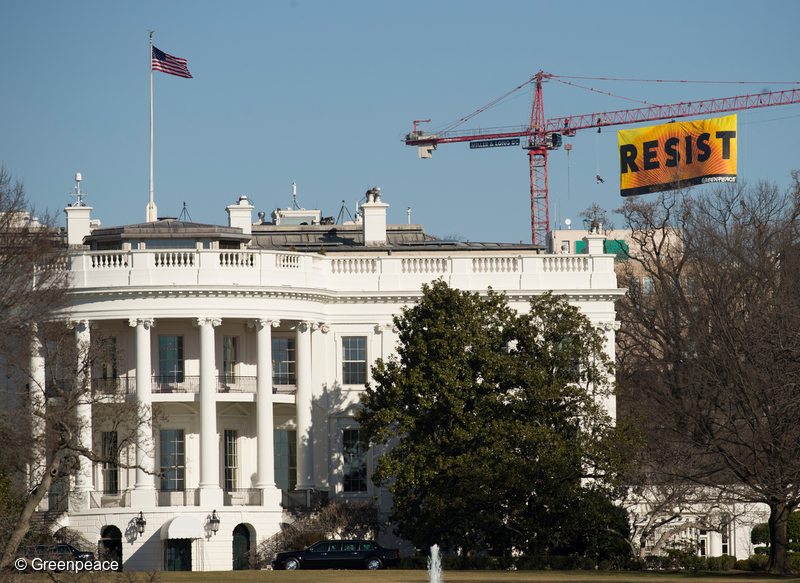
Greenpeace Activists Deploy “Resist” Banner Above the White House

http://www.greenpeace.org/usa/news/breaking-greenpeace-activists-deploy-resist-banner-above-the-white-house/
Days after Trump’s Inauguration, Activists Call for a Sustained Movement
Resist Trump Banner Action
Greenpeace activists deploy a banner on a construction crane near the White House reading "RESIST" on President Trump's fifth day in office.The activists are calling for those who want to resist Trump's attacks on environmental, social, economic and educational justice to contribute to a better America.
© Greenpeace
FOR IMMEDIATE RELEASE:
January 25, 2017
Washington, DC – This morning, seven activists deployed a 70-foot by 35-foot banner of the word “Resist” above the White House. The activists from around the country are still in place, calling for those who want to resist Trump’s attacks on environmental, social, economic, and educational justice to contribute to a better America.
LIVE UPDATES:
PHOTOS:
“People in this country are ready to resist and rise up in ways they have never done before,” said activist and Greenpeace Inc. Board Chair Karen Topakian. “While Trump’s disdain and disrespect for our democratic institutions scare me, I am so inspired by the multigenerational movement of progress that is growing in every state. Greenpeace has used nonviolence to resist tyrannical bullies since 1971, and we’re not going to stop now.”
The Greenpeace USA activists say they are prepared to stay in position throughout the morning to reach as many people as possible through live broadcasts on Greenpeace USA’s Facebook page, tweets from the activists’ twitter accounts, and media interviews.
“The sun has risen this morning on a new America, but it isn’t Donald Trump’s,” said Pearl Robinson, one of the activists who unfurled the banner. ”I fear not only the policies of the incoming administration, but also the people emboldened by this election to commit acts of violence and hate. Now is the time to resist. We won’t stand rollbacks on all the progress the people have made on women’s reproductive rights, LGBTQIA rights, the heightened awareness of state-sanctioned violence on black and brown folks, and the progress we have made on access to clean and renewable energy, an issue I have personally worked on my entire adult life.”
The action this morning comes after days of sustained protests against Trump, including the four activists who disrupted Rex Tillerson’s confirmation hearing with “Reject Rex” signs earlier this month, the veterans arrested in Senator John McCain’s office last week, and the hundreds of thousands of participants in Women’s Marches across the country over the weekend.
Since Trump has taken office, his administration has removed all mentions of climate change and LGBTQ rights from the White House website, taken steps to bring back the Dakota Access and Keystone XL pipelines, and issued a press gag order on all employees of the Environmental Protection Agency and the Department of Agriculture.
##
For live updates, viewers can tune into the Facebook Live broadcast and follow tweets from the activists.
For interviews with the activists:
Cassady Craighill, 828-817-3328
For additional updates and visual requests:
Travis Nichols, tnichols@greenpeace.org, 206-802-8498
Jason Schwartz, jason.schwartz@greenpeace.org, 347-452-3752
Visual location: The Ellipse, White House South Lawn

Friday, January 13, 2017

BANNER YEAR: AT A TIME OF HEATED RACE RELATIONS IN AMERICA, DREAD SCOTT WADES INTO THE FRAY

Dread Scott photographed in Brooklyn on October 3, 2016. ©KATHERINE MCMAHON
Dread Scott photographed in Brooklyn on October 3, 2016. 
©KATHERINE MCMAHON
For the first time in quite a while in America, people (on both sides of the political fence) are holding up signs. In a world flooded with pictures, a world where, for decades, the intellectual and populist conversation has focused on image saturation, and where advertisers seek to gain and retain audience attention with flashing GIFs and innovative visual marketing techniques—analog signs have regained some of their poignancy, and impact. In the raucous election year that just ended, we were reminded of the power of the placard, the banner, the Sharpie-scrawled scrap of cardboard taped to a stick, whether it says “Make America Hate Again” or “Women for Trump.”
What could this mean for the art object? This past July, several days after the shootings of two black men by police officers—Philando Castile in Minnesota and Alton Sterling in Louisiana—a banner appeared in the Chelsea gallery district in New York. In white lettering on a black ground, it read, A MAN WAS LYNCHED BY POLICE YESTERDAY, and it fluttered for a week in front of the Jack Shainman Gallery on West 20th Street. Like a cultural signpost of our digital day, it ricocheted around the art world, and then on to the wider world, via the Instagram account of MoMA PS1 director Klaus Biesenbach, who re-posted a video of the artist Dread Scott installing it. The banner is an update of a flag that read, A MAN WAS LYNCHED YESTERDAY, and that the NAACP hung outside its Manhattan headquarters after each such death between 1920–1938.
Dread Scott should be a familiar name to those versed in landmark Supreme Court decisions—as well as recent art history. In 1989, Scott, then a student at the School of the Art Institute of Chicago (SAIC) and still known by his birth name, Scott Tyler, showed an art installation called What is the Proper Way to Display a U.S. Flag? (1988) at the school. In the artwork, he placed an American flag on the floor in front of a photomontage of South Korean students burning U.S. flags and of coffins draped with U.S. flags. The most direct route to the photographs involved trampling on the stars and stripes. Gallery audiences had the choice of whether or not to take that transgressive step; if they did, they could access a logbook, where they could participate in the piece by writing down their reactions.
Subsequent outcry from the public, massive protests by veterans, constant media coverage, the Illinois state legislature defunding the SAIC (save for $1), and even the condemnation of then newly elected President George H. W. Bush were all part of a nationwide examination of the exact question that Scott posited: “What is the proper way to display [the] flag?” The controversy unfolded a couple of months in advance of a case before the Supreme Court, Texas v. Johnson, that would ultimately favor the First Amendment rights of the individual to desecrate the flag over the symbolic resonance maintained when the federal government protected the flag from abuse. Seventeen years later, as the Black Lives Matter movement unfolds, Scott continues his protest into the 21st century through political art.
Dread Scott, What is the Proper Way to Display a U.S. Flag?, 1988. COURTESY THE ARTIST
Dread Scott, What is the Proper Way to Display a U.S. Flag?, 1988. 
COURTESY THE ARTIST
Imet Scott in a Chinese restaurant in New York on a muggy day in August. The artist, ganglier than he appears in photos, sported a dramatic Mohawk. For a man at the center of two landmark sociopolitical confrontations between artist and state, you might expect him to be grave, but he smiled after we talked about being in the midst of the hottest summer on record. “Ecologically,” he said, “that is a truly dangerous thing both now and in the future. Do the Right Thing opens with Sam Jackson saying, ‘It’s hot.’ And he’s not just talking about the weather. I think that that is very true, it was a very hot, long summer, . . . yes, quite literally, but more shrewdly, metaphorically.”
Scott installed his banner outside Shainman’s gallery on July 7, as part of artists Hank Willis Thomas and Eric Gottesman’s exhibition, “For Freedoms,” a show for their super PAC of the same name. (Earlier this year I myself flirted with the idea of forming a PAC based on combining my initials with an artist’s, but it hadn’t happened. Like so many, I chose to show my solidarity with Scott by re-posting A Man Was Lynched By Police Yesterday on Facebook.) Scott made the banner in 2015, in response to the killing of South Carolina resident Walter Scott during a traffic stop. Later on the same day that he installed it at the gallery, five police officers were shot dead in Dallas during an anti-police-brutality demonstration there, which led Fox News to do a report on Scott’s banner, headlining it, “Art gallery stands by anti-police violence flag in wake of deadly Dallas shooting.” In response to the Fox story, Scott and the gallery both got a series of ugly emails. “I hope someone lynches you. You are not an artist you’re a piece of shit,” read one of the worst.
Shainman became concerned for the safety of his staff. “It is the kind of work that you can’t ignore,” he told me. “It makes everyone take a stance. Never in all my years showing art (of all different sociopolitical degrees) have I seen anything like the public reaction. I was worried about my employees and about our visitors.” Gallery director Joeonna Bellorado-Samuels went to the local precinct to meet with its Community Affairs officer who, after a two-hour conversation, put the gallery under special alert, with a patrol unit passing by several times a day. Shainman refused to take A Man Was Lynched by Police Yesterday down until his landlord, ROY-AL Company/Kalimian Organization, insisted on it, threatening legal action. (As it happens, that echoes history: the original banner stayed outside the NAACP headquarters for years, until the organization was threatened with losing its lease.) Scott’s banner was up for only a week but, he suggested over lunch, during that short time it “began to embody the fears of gallerygoers, the police, landlords, and even Fox News.”
Before hanging his banner outside the gallery, Scott, accompanied by several Shainman staff members, had activated it by taking it to Union Square during the protest there after the deaths of Castile and Sterling; it evoked the way the NAACP flew its flag during the ’20s and ’30s, following the lynchings of individual black men. Today, Scott said, black people “are killed by the police in greater numbers than they were at the height of lynching. The police actually kill more white people than black people, but the percentage of those murdered is disproportionately black [to the general population]. You’re approximately six times more likely to be killed by the police if you’re black than if you’re white. That is the terror that is perpetuated among people today, and that is the legacy of lynching. I want this flag to be a phantasm of the past: both as a means to mark this horror from the past that exists in the present, but also as the resistance from the past that persists in the present. The flag was flown because the NAACP organized people to stop lynching.”
Dread Scott, A Man Was Lynched by Police Yesterday, 2015. COURTESY THE ARTIST AND JACK SHAINMAN GALLERY
Dread Scott, A Man Was Lynched by Police Yesterday, 2015. 
COURTESY THE ARTIST AND JACK SHAINMAN GALLERY
That wasn’t the only way the NAACP fought lynching. Along with the John Reed Club and other like-minded organizations, it curated art exhibitions, and sold the art to raise money for anti-lynching efforts. José Clemente Orozco and Isamu Noguchi were among the artists who donated work to these shows. Noguchi’s sculpture Death (Lynched Figure), 1934, now at the Noguchi Museum in Queens, based on an International Labor Defense photograph of a torched, castrated, lynched black man, was a denunciation of the horror of lynching.
It was crucial for Scott that, aside from the slight change in language, his flag precisely replicate the original. I wanted to challenge him on this assertion. Scott discussed A Man Was Lynched by Police Yesterday as if it were all content and operation, and not deliberately jarring formally. At first he resisted me. Doing research at the Library of Congress, he could find only six photographs of the NAACP banner and said, “it might be slightly off, but it’s pretty damn close.” He rattled off dimensions. The original was 9 by 6½ feet; his is smaller—a little over 7 by 4½ feet—but its proportions are the same. There are other differences. The font the NAACP used, he said, “would have been a hand-cut one that the flag maker would have designed, based on what sign painters would have used. So it’s very much an Art Deco font. I’ve tried to match the individual rendering, but mine is not hand cut. I chose the closest font I could find and tweaked that in Illustrator to evoke a semblance of the original.”
I countered that his flag is not exactly a replica. There is a way in which he aestheticizes the content—the word “lynched” seems enlarged through the addition of “by police yesterday” under it. “People might not know the original flag,” Scott said, “but they know my work and that it refers to an original. In my practice I am concerned with this conceptual framework, where the past can sit in the present. History sets the stage for the present, and it resides in the present in a new form.”
Not able to let go of the art-historical import of the flag, I pushed on about flags in art from Raoul Dufy to Jasper Johns and then reminded him that, in A Man Was Lynched by Police Yesterday, there is no representation of a figure being lynched; all we have is the text. This seemed important because, as Shainman pointed out to me, people kept thinking that despite the lack of a figure they saw the flag as reading a black man was lynched by police yesterday. The text manages to suggest a figure. “Is the association with a black male because the flag itself is black?” I asked Scott, “or is there something else going on?”
Excitedly, he replied in rapid fire: “Yes, so part of reading the word ‘black’ is that people actually do associate lynching exclusively with black people, and while there were people of other ethnicities [who] were hung, lynching was something that basically happened only to black people. It wasn’t about ropes and trees; it was about systemic terror for the black population.”
Dread Scott photographed in Brooklyn on October 3, 2016. ©KATHERINE MCMAHON
Dread Scott photographed in Brooklyn on October 3, 2016. 
©KATHERINE MCMAHON
Scott Tyler was born and raised in Hyde Park, Chicago. Like his father, he went on to train as a photographer. To this day, that training helps him frame what he wants people to see. The controversy sparked by What is the Proper Way to Display a U.S. Flag? resulted in instant success for the young artist. Not deterred by police protesters and death threats, he appeared on national television in 1990 wearing a T-shirt featuring an image of Mao Tse-tung (he told me he remains a Communist).
In the ’90s, and particularly after the famously incitant 1993 Whitney Biennial, Scott was categorized as an “identity politics” artist. Recently, though, with glowing reconsideration of these artists and their work (think Robert Gober’s 2014–15 MoMA exhibition), his art has also become understood in a more nuanced context. “The identity politics movement in art in the ’90s was very important,” Scott said. “I like a lot of the work that came out of the ’80s and ’90s, and I’m friends with some of the people who became prominent. People were looking at various cultures and people who’d faced various forms of oppression, be it because of their gender, sexual orientation, race, ethnicity, nationality. We have to stand with the oppressed, and that’s a really good thing. However,” he continued, “philosophically and methodologically, what undergirded multiculturalism was a sort of relativism. People assumed, ‘Well, I as a black man can understand my experience, and you, say, as a black woman could never understand it.’ ”
Cultural relativism was a popular position in the 1990s. In the catalogue for the 1993 biennial, for instance, David Ross, the Whitney Museum’s director at the time, wrote, “Artists insist: know thyself.” Scott agrees that owning one’s experience is valid, but went on, “Well, first of all, we’re both still black, and most experience and understanding in the world is secondary experience…even what is non-stigmatized. I know it sounds old-fashioned, because now I keep returning to certain ‘truths’ that as humans we have to stand by.”
Thomas included Scott in his and Gottesman’s show this past summer at Shainman because of his way of alighting on the authentic in his work. “It unapologetically challenges aspects of our government, our economy, and our society,” Thomas said. “We wanted Dread to be a part of this from our very first community engagement project because of his track record for keeping it real.”
Scott’s penchant for keeping it real means that he has not been afraid to confront the government head-on with these truths. In 2009 he installed 12 coffin-scaled light boxes, each showing a photograph of an African-American or Latino/Latina teenager, for a piece called …Or Does It Explode?. The boxes also had an audio component: a speaker in front of each box played the teenager talking about his or her life goals and aspirations. Created in collaboration with the teenagers and very much akin to both flag works, it is an artwork that can live in a gallery but is ultimately for the public at large. Scott took the title from Langston Hughes’s 1951 poem “Harlem,” reinvigorating the lines that are trotted out every February for Black History Month calendars. Displayed in Philadelphia’s Logan Square, near the city’s Family Court Building, it confronted the judicial system with the lives of these teenagers held in a balance that might not exist absent systemic racism. Scott told me that one judge, who had to approve the work before it was installed, asked if there were anything she could do to intervene in the lives of these teenagers, in the hope of preventing their ending up dead, like many of those who had appeared before her.
Why limit yourself to audio and photography in that artwork, I asked Scott. Why hadn’t he made the jump to video? “There is a way in which video doesn’t do enough,” he said. “Look at all the videos of unarmed black people being shot by the police, and they can be virtually meaningless as evidence. My earliest work that was explicitly trying to explore political ideas had actual text; it was just static written text. I quickly moved into oral text, in part because some of the people I wanted to reach—not the majority of the actual audience—don’t enjoy reading. With audio, more people will listen.
“Then,” he added, “there’s also the influence and inflection of voice and culture that don’t translate into writing. Yes, Zora Neale Hurston made some real breakthroughs in talking about vernacular language, but it’s still different when you hear the actual voice. With …Or Does It Explode?, it’s extremely important that the voices of the people [be] brought outside of their day-to-day lives and into an art context—into a gallery context, or even a museum context.”
Dread Scott, …Or Does It Explode?, 2009. COURTESY THE ARTIST
Dread Scott, …Or Does It Explode?, 2009. 
COURTESY THE ARTIST
In the next year, Scott will have exhibitions at galleries and museums throughout the United States, from Chicago and New York, to Memphis, Winston Salem, and New Orleans. He doesn’t think about his work in terms of the art world; he thinks of it in terms of the possibility of contagion. His next major project, Slave Rebellion Reenactment, is a re-creation of the German Coast Uprising of 1811. It will feature 500 men and women armed with machetes, cane knives, sickles, muskets, blunderbusses, and clubs. “You know,” he said, “the items that people rebelled with.”
His concern for historical accuracy pops up even in the dress of the participants. “In the original rebellion, the generals, formerly slaves, seized French militia uniforms,” he said. “They wanted to look like an army to other slaves.” The participants, outfitted in period costume, will start out 40 miles up the Mississippi River from New Orleans and walk to within 15 miles of the city, to the location, 26 miles from the Andry Plantation (now LaPlace), where the rebellion took place. At the time, it was all sugar plantations. Now, Scott pointed out, it is populated by strip malls, box stores, trailer parks, gated communities, and oil refineries.
Earlier, we’d spoken about the fear of allowing black people to arm themselves, in connection with the 1960s and ’70s, the time of the Black Panthers. “It actually began in the Dred Scott Supreme Court case decision,” Scott said. “One of the arguments was, ‘Look, if they were citizens, we’d have to allow them to have guns.’ The founding fathers were not so foolish as to allow black people to be armed. It’s very explicit. We don’t want the people we denigrate and abuse to have access to weapons, because then what happens? Then they might come for us.”
Emboldened by his mention of Dred Scott, the famous 1857 case where a slave sued for and was denied his freedom, the most obvious question came to mind, “Why Dread Scott, why that name?” His eyes seemed to glaze over, surely from having had to answer this so many times over the years. “Scott Tyler was a figment of my mother’s imagination. It’s my government name. When I came of age, I was a punk-rock kid in the 1980s and ’90s; all my friends were in bands and had stage names. I knew Virus X, I hung out in passing with Joey Shithead. People had all sorts of colorful names, and I thought well, all right, just because I’m not in a band doesn’t mean I can’t have a different name. So my parents named me Scott and I had dreadlocks so I thought, I’ll be Dread Scott. With the name like the work, I wanted people to have to know that [to paraphrase from the Dred Scott decision,] there are no rights that a black person has that a white person is bound to respect. I chose to spell it differently than the historic figure, in order to bring up the concept of dread. If people see me or my work with dread, if they are threatened by it, well, those people who want to exploit society should be threatened by art.”
Andrianna Campbell is a doctoral candidate in the Department of Art History at the CUNY Graduate Center, specializing in American art and modern and contemporary art of the Americas. She currently holds the CASVA Chester Dale Fellowship at the National Gallery in Washington, D.C.