Thursday, October 22, 2015

About the exhibition: "Party Out of Bounds: Nightlife As Activism Since 1980"

The Politics of Partying: Nightlife as Activism

visual aids
456
SHARES
Sometimes the most powerful political action is simply self-expression. It seems like an apparent enough notion when you stop to think about it but in this age of the ubiquitous selfie, self-expression often feels like a narcissistic exercise in self-admiration.
New York in the late seventies and early eighties was quite different. To be seen in public playing with gender and freely conveying your sexuality was nothing short of radical and often had severe consequences. When the AIDS epidemic hit, political action turned militant and as scores of the downtown population died-off, nightlife played refuge to an embattled community and provided crucial cathartic release. It is precisely this convergence of sex, politics, death, grief and--at the same moment--celebration that is at the heart of this year’s annual Visual AIDS exhibition at La Mama Galleria, titled Party Out of Bounds: Nightlife As Activism Since 1980 (through Oct. 10). Co-curator Emily Colucci beautifully eulogizes the era with this invocation:
“We dance for The Saint, The Anvil, Mineshaft, the Toilet, El Mirage, J’s and the Hellfire Club. We dance for MEAT, the Clit Club and Pork. We dance for club Chandelier, Squeezebox, the Mudd Club, Peppermint Lounge, Danceteria, AREA, the Roxy, the Tunnel, Limelight, Palladium and Paradise Garage. We dance for those spaces still operating that have been irrevocably altered by the ever-evolving city. And finally, we dance for those spaces that continue in the legacy of the formative, campy, radical, revolutionary vision of the bygone days and nights, sustaining nightlife’s legacy of activism.”
The show includes artworks and artifacts by such luminaries as Keith Haring, David Wojnarowicz, Peter Hujar alongside — and in conversation with — contemporary work by Kia Labeija, John Waters, Wu Tsang, and Chloe Dzubilo among others.
I sat down with the co-curators Colucci and Osman Can Yerebakan to talk about Party Out of Bounds, the exhibition’s conception and the current state of New York City nightlife.
Emily
Photo with head of Emily Colucci by M. Sharkey
XXM: Can you tell me a little bit about the intersection of activism and nightlife as it pertains to the show?
Emily Colucci: These clubs were places for community very early on in the crisis. Before they even knew what to call AIDS, clubs threw benefits for the community members and performers who were getting sick. There were benefits for Hibiscus, who was part of The Cockettes, at Danceteria in 1981 or ‘82.
Osman Can Yerebakan: Keith Haring designed cards for benefits. It was a place to see that you were not the only one. A person living with AIDS or HIV could share their diagnosis with other people, their experience.
EC: A lot of clubs had ACT UP benefits. GMHC’s first benefit was in a club. This really was for community to come together. That narrative is sort of lost in what people think of AIDS activism. People think of ACT UP’s Stop the Church and these kind of very public moments. I think the show is looking at nightlife as a subset of activism that has not been looked into much.
When I think of nightlife I tend to think of performance, both by the patrons and also the paid performers. Something that comes to mind is Leigh Bowery. Can you talk about personal expression and how that relates to politics? 
EC: I was just going to say, someone like Leigh Bowery or Ethyl Eichelberger or John Sex… even if what they were doing was not obviously political —they weren’t carrying around signs — I find these transformations into their personas to be political. It was a safe space for people. You can be whoever you want to be inside the space. Looking at Nelson Sullivan’s videos you see that it was a special place where people could try on different identities without fear. While this is not political in the sense of capital “P” Politics, I find that it is political. Put on these different expressions, play around with gender, sexual identity…
OY: The act of being who you are is a political way of saying “fuck you.”
EC: And that is part of our show. I see that as activism. And art as well.
OY: Even outside of AIDS, gay nightlife culture is what we do.
EC: That is why we specifically called the show “Nightlife As Activism” rather than just AIDS activism, because while that is part of it, there are other sorts of activism happening.
OY: Gender.
EC: Sexuality.
Osman Can Yerebakan
Photo with head of Osman Can Yerebakan by M. Sharkey
This is a powerful idea and I think it is also a very interesting way to frame performance moving into the future. I noticed going through the catalog that there are a number of historical artifacts, which act as touchstones for the contemporary artists in the show. Can you talk about the dialogue between these historical remnants and contemporary interpretations or reactions?
OY: We wanted to bring it to now because definitely there is a legacy that is still being referred to, artists like Kia LaBeija or Conrad Ventur are still holding onto a legacy.
EC: It was important to show these not just as artifacts. I think a lot of people approaching the show think it is just about the '80s but it was really important to bring it into the present, to show that activism – and specifically AIDS activism – is happening now too.
OY: It is an ongoing dialogue.
EC: The HIV/AIDS crisis is not over. It was important to put all these objects in communication with each other.
OY: This is the period to make that bridge between the past and the present.
What are some of the highlights?
OY: I really like Conrad’s piece. It is basically a YouTube performance projected onto a disco ball. It is a new piece, so we don’t know exactly what is coming. I also love Chloe Dzubilo’s drawings.
EC: It’s like choosing your favorite child! I am really excited about Hunter Reynolds. He is doing a new work based on photographs we found in the Visual AIDS archive which are documents of his first mummification he did at The Lure for a Visual AIDS benefit. He has a solo show that opened that uses some of these mummification photos from the present. To be able to see that historical legacy… I don’t think anyone has seen these photos before. So this is a really important moment in his career and his history, in Visual AIDS’s history, in activist history, and it really shows the merging of these things together.
As I was explaining earlier, I was lucky enough to see a mummification performance around the time these documents were created, in 1998. Because it was so long ago my mind is a bit fuzzy about who was doing the performance. I had always remembered it as Ron Athey, which it may well have been. For the audience reading this interview, can you talk about what this performance is?
EC: Hunter has done these mummification performances at The Lure and everywhere. Typically what happens is he stands while assistants cover him in plastic and tape and completely mummify him expect for one arm. He is completely mummified head to toe and then he is laid down, or he is taken somewhere. The tape they use is usually very glittery or some interesting mix of colors. Eventually, after the performance goes on for awhile, they cut him out of it and these mummification skins are also exhibited [in the P.P.O.W. show running concurrently]. It has many meanings: rebirth and there is also the fetish aspect, which you can’t ignore.
OY: We also have a London leg of the show. Artist John Walter is doing  a funny psychedelic video.
EC: And we can’t talk about highlights and not talk about John Waters! That is my favorite piece.
aldo_hernandez
Poster art by Aldo Hernandez
The giant Claes Oldenburg-esque bottle of…
EC: Poppers.
OY: It is a symbol for the whole thing actually.
Can you talk a little about the performance schedule?
OY: There will be an after-party called No Pants No Problem by Jessica Whitbread, who is also in the show. She does these parties around the world, basically as the name suggests: No pants…
EC: And no problem. It is basically an underwear dance party.
OY: It started as a metaphor for getting over prejudice, your worries. You are free. You mingle. You meet people.
EC: Jessica is an HIV-positive queer woman and an AIDS activist. She started doing these parties in part because she felt alienated from nightlife and didn’t know how to navigate the different clubs.
OY: It is usually a man’s world.
EC: So she started to do these parties to break down barriers around sexuality and gender. There are kissing competitions and party games to make people….
OY: Relax.
EC: And to be vulnerable.
OY: To think: I am not the only one.
EC: That will be right after the opening on September 18 at 10:30 p.m. On October 8 is Linda Simpson's Drag Explosion. I like to explain it as your drag mother showing her vacation photos. She projects slides of photos taken from backstage at the Pyramid from the 1990’s to now. It goes from backstage at the Pyramid club to performances to ACT UP protests. Everything we are talking about in the show in the frame of drag. And she narrates it.
OY: Kia LaBeija will be one of the performers. Fredrick Weston will be doing a collage around the bar at Leftfield on the Lower East Side.
When I think about contemporary nightlife, I am thinking about performance and also blowing-off steam, but it is hard to imagine physical spaces today that feel actively political. Where do you think interesting political expression is taking place today?
EC: That is the question. I think Jessica’s parties are that. I think the Drag Ball scene is still doing interesting stuff.
OY: But you don’t see it when you go out.
Why is that? 
EC: I think because of Grindr and Tinder and all of the people online.
I think the landscape has changed because of the apps and, in the city at least, gentrification.
OY: Maybe it is happening online? They group-up and then they gather.
Party Out of Bounds: Nightlife As Activism Since 1980September 18-October 10. Gallery Hours: Wed.-Sun. 1 to 7 p.m., or by appointment at La MaMa Galleria, at 47 Great Jones St.
Follow M. Sharkey on Instagram @msharkeyfoto

Friday, October 16, 2015

Implicit Bias-- Seeing the Other: Seeing Our Self

September 18 - December 5, 2015

Opening Reception & Meet the Artist: Friday, September 18, 7-9pm
Curator & Artists' Talk Saturday, October 17 at 3:30pm

Joan Hisaoka Healing Arts Gallery in proud partnership with all six Busboys and Poets locations will unveil IMPLICIT BIAS - Seeing the Other: Seeing Our Self. Curated by Shanti Norris and Carol Dyson, the exhibition features over 45 artists from the entire east coast region including Holly Bass, Leslie Berns, Alex Braden, Tim Davis, Nehemiah Dixon, III, Justyne Fischer, Shaunt'e Gates, David Ibata, Rose Jaffe, Jeffery Kent, William Larkins fromlorton Art Program, Tim Okamura, Manuel Palacio, Herberth Romero, Gwenn Seemel, Ann Stoddard, Eric Telfort, Raphael Warshaw, Omolara Williams McCallister, and Helen Zughaib.

Artists exhibiting at Busboys and Poets include: Salama Arden, Cedric Baker, Leslie Berns, Gina Bowersmith, Summer Brown, Travis Childers, Hebron Chism, larissa Danielle, Nehemiah Dixon, III, Duly Noted Painters, Phoebe Farris PH.D, Adrienne Gaither, Aziza Gibson Hunter, Winston Harris, Courtnee Hawkins, David Ibata, Rose Jaffe, Jeffery Kent, Aselin Lands, Pamela Lawton, Marla McLean, Gringoh, Manuel Palacio, Darien Reece, Herbert Romero, Melina Sapiano, Gwenn Seemel, Shani Shih, Elka Stevens, Eric Telfort, Kim Thorpe, Raphael Warshaw, Will Watson, Jennifer Weigel, Curtis Woody,  and Helen Zughaib..
IMPLICIT BIAS: A subtle attitude or belief that often lies beneath our conscious awareness. This underlying behavior can subliminally cause stereotypical and sometimes unjust associations to form when relating with people of a different cultural background. IMPLICIT BIAS may also cause an unconsciously prejudice decision-making process towards policy and other institutional methodology.

"Maybe, we now realize the way racial bias can infect us, even when we don't realize it. So we are guarding against, not just racial slurs, but we are also guarding against the subtle impulse to call Johnny back for a job interview, but not Jamal." - President Barack Obama's Charleston eulogy at the funeral of the Rev. Clementa Pinckney

We are living in important and dangerous times, where racial bias has stepped into a place that can no longer be ignored. IMPLICIT BIAS - Seeing the Other: Seeing Our Self is an exhibition strives to reflect these serious matters with honesty, integrity, and an urgency these times deserve. The exhibition will not solely depict an introspective view of Bias, but extends to more prevalent matters, such as injustice in all its forms: police, judicial, education, voting rights, and urban planning for example.
IMPLICIT BIAS - Seeing the Other: Seeing Our Self will be on view from September 18 - December 5, 2015, with the Opening Reception on Friday, September 18th, 7-9pm.
And mark your calendars for the following special events:
Media Rise Festival 2015: Problematic Perspectives WorkshopHosted by Media Rise, and featuring Smith Center Co-Founder & Executive Director and co-curator of IMPLICIT BIAS - Seeing the Other: Seeing Our Self, Shanti Norris, join us at 12pm on Thursday, October 1st for Problematic Perceptions, a workshop in which participants discuss how media shapes their perceptions about people of color.
Implicit Bias Curator & Artists' TalkJoin us on at 3:30pm on Saturday, October 17th for the IMPLICIT BIAS Curator & Artists' Talk, hosted by Sheldon Scott, for a rare opportunity to hear the featured artists speak about this important exhibition.
"Code Switching" with Kelly King: As a part of IMPLICIT BIAS - Seeing the Other: Seeing Our Self, join us at 6:30pm on Thursday, October 22nd for the "Code Switching", a moving dialogues workshop with Contradiction Dance and Kelly King.
"Sightless Party" Hosted by Holly Bass and Micah John: Friday, November 13th, 7-9pm
 
Gallery Hours: Wednesday to Friday, 11am-5pm, Saturday, 11am-3pm, and by appointment.
Please note: The gallery will be CLOSED on the following Saturdays, September 26 and October 24. The gallery will also be CLOSED Thursday, November 27 through Saturday, November 29 for Thanksgiving.
Joan Hisaoka Healing Arts Gallery is located at 1632 U Street, in Northwest DC
Learn more about the Joan Hisaoka Healing Arts Gallery

Thursday, October 15, 2015

'Homeland is racist': artists sneak subversive graffiti on to TV show

Three graffiti artists hired to add authenticity to refugee camp scenes in this week’s episode of Homeland have said they instead used their artwork to accuse the TV programme of racism.
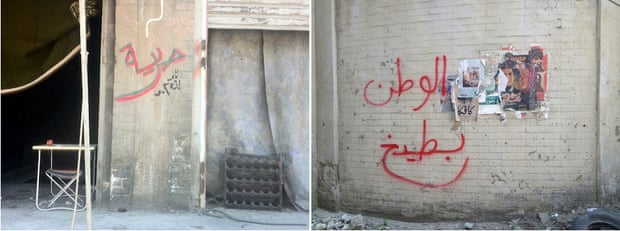
The graffiti here says: ‘Homeland is racist.’
 The graffiti here says: ‘Homeland is racist.’ Photograph: Courtesy of the artists
In the second episode of the fifth season, which aired in the US and Australia earlier this week, and will be shown in the UK on Sunday, lead character Carrie Mathison, played by Claire Danes, can be seen striding past a wall daubed with Arabic script reading: “Homeland is racist.”
Other slogans painted on the walls of the fictional Syrian refugee camp included “Homeland is a joke, and it didn’t make us laugh” and “#blacklivesmatter”, the artists – Heba Amin, Caram Kapp and Stone – said in a statement published online. 
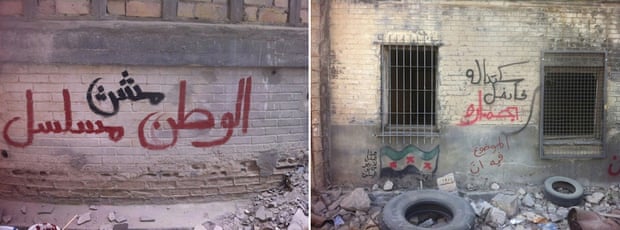
The graffiti on the left says: ‘Freedom … now in 3D’. The one on the right says: ‘Homeland is watermelon’ (which is slang for not to be taken seriously).
Pinterest
 The graffiti on the left says: ‘Freedom … now in 3D’. The one on the right says: ‘Homeland is watermelon’ (which is slang for not to be taken seriously). Photograph: Courtesy of the artists
The artists said they had been contacted in June by a fellow street artist who had been approached by a production company looking for people to add authenticity to the set – intended to portray a refugee camp on the Syrian-Lebanese border, but filmed on the outskirts of Berlin.
“Given the series’ reputation,” they wrote, “we were not easily convinced, until we considered what a moment of intervention could relay about our own and many others’ political discontent with the series. It was our moment to make our point by subverting the message using the show itself.”
In an early meeting with the production team, they were, the statement claims, handed images of “pro-Assad graffiti – apparently natural in a Syrian refugee camp”.
The trio decided instead to use the opportunity to air their criticisms of the show, adding graffiti stating: “Homeland is NOT a series”, “The situation is not to be trusted” and “This show does not represent the views of the artists.”
The Arabic script was not checked by producers, they claimed. “The content of what was written on the walls … was of no concern. In their eyes, Arabic script is merely a supplementary visual that completes the horror-fantasy of the Middle East, a poster image dehumanising an entire region to human-less figures in black burkas and moreover, this season, to refugees.”
The message on the left says: ‘There is no homeland’. The one on the right says: ‘The situation is not to be trusted’ and ‘This show does not represent the views of the artists’.
Pinterest
 The message on the left says: ‘Homeland is not a series’. The one on the right says: ‘The situation is not to be trusted’ and ‘This show does not represent the views of the artists’. Photograph: Courtesy of the artists
Amin told the Guardian: “We think the show perpetuates dangerous stereotypes by diminishing an entire region into a farce through the gross misrepresentations that feed into a narrative of political propaganda.
“It is clear they don’t know the region they are attempting to represent. And yet, we suffer the consequences of such shallow and misguided representation.”
Homeland has frequently run into controversy during its five seasons, particularly over its depiction of the Muslim world and its portrayal of an apparently cosy relationship between Al-Qaida and Hezbollah.
After season four depicted Islamabad as a “hellhole”, a Pakistan embassy spokesperson, Nadeem Hotian, said: “Maligning a country that has been a close partner and ally of the US … is a disservice not only to the security interests of the US but also to the people of the US.”
Showtime has not yet responded to the artists’ claims. The network president, David Nevins, said earlier this year, ahead of the filming of season five, that Homeland would not necessarily continue with Islamist protagonists: “We’re not necessarily going to stay now and forever [focusing on] US relations in the Muslim world … We’re exploring a few different possibilities and may change it up a little bit.”
Nevins added of the show’s writers: “They never shied away from anything difficult. I want them to go right into the teeth of it again.”

TASSELS AND TRANSGRESSIONS ON THE THIRD RAIL: SHAKING IT UP FOR SOCIAL JUSTICE THROUGH BURLESQUE

Article by S.T. Shimi | October 7, 2015
Editor’s Note: We’re thrilled to publish this article by one of our Barbeque, Burlesque, and Bourbon headliners and longtime members, S.T. Shimi aka Black Orchid. Come on out to see Black Orchid, Sadie Hawkins, and a host of other fierce and fabulous artists at 3BQ, ROOTS Inaugural Un-Gala, on October 24, 2015. Get your tickets today! 
I’ve been a ROOTS member for at least 15 years now. In that time, I grew out my hair, got a few more tattoos, became a married lady…and acquired a few different performance personas.
S.T. Shimi is the one I’ve owned since kindergarten. What my parents call my “pen name,” that I use for academia, literary efforts, “serious” theater/performance/storytelling work. “Shimarella” is my PG-friendly “glam-tertainer” (my term for any style of performance that utilises the purely sparkly, fun side of show business): she wears sparkly costumes, plays with fire, spins hula hoops, and occasionally climbs aerial silks.
Black Orchid is the persona I’ve been most associated with recently. She’s my most adult and sultry character who pole dances (since 2011) and performs burlesque (since 2009). She doesn’t speak much because she doesn’t have to – the language of the body is all she needs.
But how does a progressive artist and activist reconcile her (body) politic with an art form that’s all about disappearing clothes?
Quite easily.
Welcome to the Third Rail
You see, for a long time now, I feel that I’ve been moving steadily towards what I think of as “the third rail” of physical and artistic expression. The kind that is about being unashamed to celebrate, exhibit, and express with a gradually denuded and intentionally sexual body. Sometimes it’s deep and transgressive theater – because burlesque is really just theater that utilizes reverse engineering to move towards a punchline of disappeared clothes – and sometimes it’s a purely joyous and fun expression of self.
What makes it “the third rail” for me is that on both sides lies strong social condemnation. On one side, moral-minded conservatives don’t think that it’s proper or ladylike that women move their hips, shake their breasts, open their legs, and touch themselves on stage. On the other side, some progressive/radical thinkers believe that openly sexual performance for an audience must be by its very nature exploitative, and that we who dance are deluded and unaware of our own victimhood. For example, I was initially told by a (now supportive) colleague that “the pole is a symbol of oppression.”
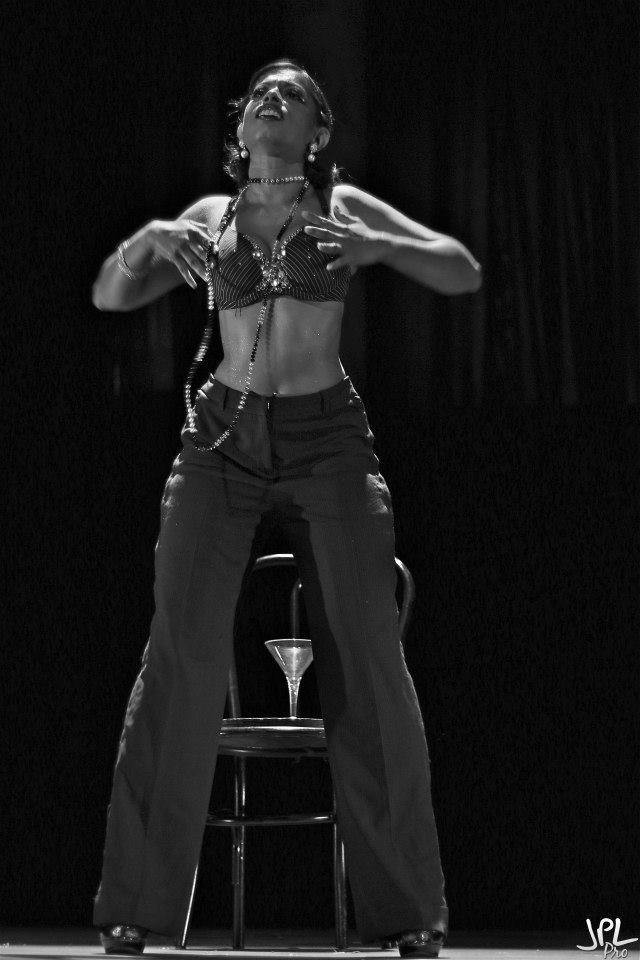
Black Orchid in "Old Fashioned Lesbian Love Story."
Black Orchid in “Old Fashioned Lesbian Love Story.”
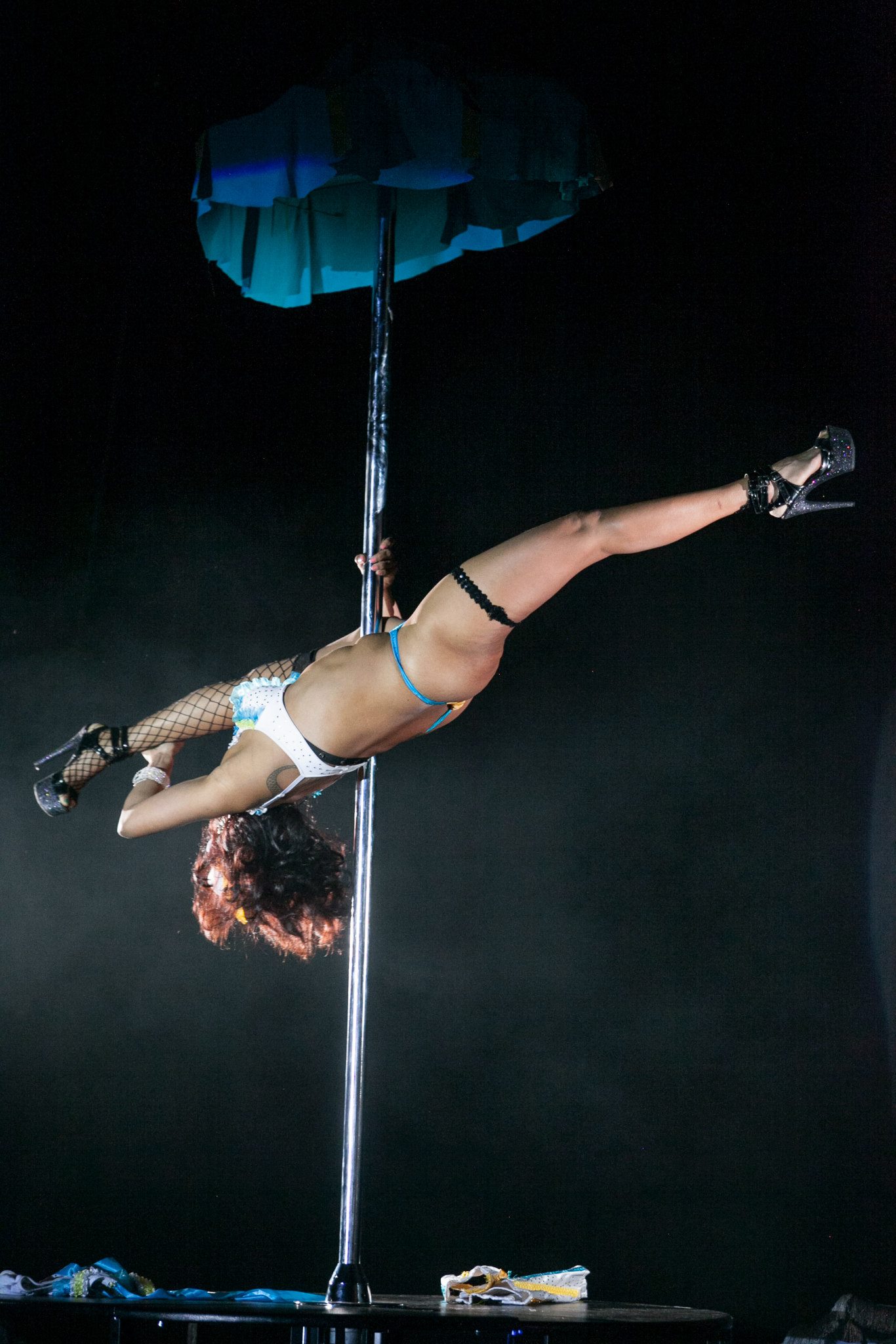
As an Asian woman, I’m also doubly aware that this “third rail” has added weight because of the repressive conservatism that many of us have questioned and rebelled against since childhood, as well as the very mixed feelings that many community activists have about adding to the sexualized and exploited stereotypes that plague Asian women (something that many communities of color can identify with). As a small, “exotic” woman, I am aware of how my body can be seen as colonized and consumable. Part of my aesthetic is intentionally using that initial, potentially dismissive impression to my advantage. There is always something in my act that upends expectations: whether it’s defying gravity by holding my body up sideways with only two points of contact on a pole while wearing 8 inch heels and a bikini, or defying heteronormativity through a performance that starts out as “conventionally” mainstream and quickly becomes queer, through dancing and stripping to music created by and about women who love women. And I am not alone among burlesque performers who make work that surprises in this way.  
When I first started taking belly dance classes in San Antonio in 1995, I thought a lot about cultural appropriation, and about exploited stereotypes, and what I could consciously reconcile with my desire to move. I thought so hard about it that I literally immobilized myself. That in itself made me unhappy and angry. I needed to move forward from that fear with as much integrity and thoughtfulness as I had within me, and hopefully I did. My continued evolution as a performing artist led me to burlesque in 2009 and pole dance in 2011 – movement and performance genres that deconstruct and challenge perceptions of how women specifically own, perform, and display our bodies in interesting and often subversive ways. While far from perfect or homogenous, the burlesque and pole communities often engage in creating a liberating world that seeks to unbind its practitioners from hidebound expectations of performing bodies. 
Neo-Burlesque & Social Justice
After its neo-burlesque (and more feminist and performance art-based) revival in the 90s, burlesque has certainly become more mainstream. Current burlesque performance can center around preservation, satire, celebration, performance art, or pure glamour, or more often, a mashup of several styles. Many of us move within these categories easily and also intentionally complicate them. With mainstream popularity comes the challenges of balancing our desires as artists for bigger stages while maintaining the integrity of what, in its modern incarnation, became a way to celebrate bodies of all sizes, a DIY production aesthetic that continues to be primarily driven by women, and an edgy performance art inspiration. Admittedly, burlesque, like any other community, continues to wrestle with issues of cultural appropriation, financial exploitation, and minority erasure, especially as the tent becomes bigger. The conversations within the community, for those that choose to have them, are passionate and ongoing.  
Can there be burlesque with an explicit focus on social justice? Absolutely. Just a few examples: Indigo Blue is an internationally known Queen of Burlesque and a queer activist who lends her name and tassels to Pride events. Sukki Singapora lobbied successfully to make burlesque legal in Singapore, has been an ambassador for Indian girls’ right to education, and was invited to Buckingham Palace in recognition of those efforts. New York-based Brown Girls Burlesque, is one of several burlesque troupes that focus on highlighting women of color who make work that is both celebratory and challenging. Several of their members are also academics — something that is not uncommon among burlesque performers. Within the ROOTS region, Fat Bottom Cabaret, an award-winning troupe featuring women of size and color in Austin, TX created a powerful Black Lives Matter dance that has been seen in national burlesque festivals. Fight The Power! was a recent burlesque show in Baltimore that featured acts about current social justice issues, and proceeds went in part to Project Innocence. As one of the producers of Legislate This! Texas, I have raised funds for Planned Parenthood locally with the help and support of other like-minded burlesque performers.
Black Orchid, defying gravity.
Those of us that choose to utilize burlesque to showcase our intersecting identities all understand that there is power in putting our bodies on the line and in people’s faces. We collectively create space where our bodies are ours alone to share as we please. Through this artform, we transgress cultural norms, telling stories that challenge misogyny, racism, reproductive injustice, and/or homophobia in provocative, empowered ways. Confusing, hypnotising, and thrilling audiences with tassel twirls and glitter is a tactic and a bonus. Sometimes it takes an audience a hot minute to realize that what they’re seeing isn’t “just another strip act.” Take your time. We’ll still be here. 
Dancing the Revolution
I believe that my sexual expression onstage is transgression. I believe my body onstage is celebration. I believe that living fully in the intersections of all my identities as a performing and creating artist is truthful and fierce. I believe, just like Emma Goldman, that a revolution is not worth participating in if I can’t dance in it. And if I can be mostly naked and covered in glitter, then all the better! 
Alternate ROOTS has always supported my growth as an artist. From performing what little I knew as a baby bellydancer at my early Cafe Bizzozos (the storied precursor to what is now ROOTS Week Late Night), to offering salient feedback on my politically toned solo theater works, to packing the insides and outsides of Efird Hall for my multi-media and aerial experiments with Billy Munoz, to inviting me to be a major part of this last ROOTS Week showcase, and now, 3BQ as my Black Orchid self. This organization has been hand in hand with me all the way. I’m so thrilled to be a part of this “un-gala” with the fiercely feminist and fiery Sadie Hawkins! 
I hope you are ready to dance this revolution. Because honey, we are going to tear this place up and then rebuild it together. 
…..
Further Reading:

S.T.Shimi AKA Shimarella AKA Black Orchid is a foxy brown performance artist who has been living and making work in San Antonio for two decades. Born and raised in Singapore, her performance work examines the intersections and contradictions of multiple identities in irreverent, provocative and visually intriguing ways. 
She has created and collaborated on several original performance works over the years,that have been seen at several major local arts festivals, as well as on stages around the country.
As Black Orchid she performs with San Antonio’s longest-running burlesque troupe Stars & Garters Burlesque, and recently won Best Use of Novelty/Prop at the Texas Burlesque Festival and Most Original Act at the San Antonio Burlesque Festival. 
Shimi teaches and trains in pole at Soft Sensuous Moves, San Antonio, and has competed and placed in pole competitions in her Division (Masters), including Miss Sexy at Miss Texas Pole Star 2014. 
For twenty years, Shimi was a company and staff member of Jump-Start Performance Co., fulfilling the roles of Artistic Director, Resident Lead Arts Educator, Education Director and representative to Alternate ROOTS along the way. Her relationship with ROOTS is a long and loving one, including stints on the Executive Board and numerous (in)famous performances at Annual Meetings.  
Shimi graduated from Dartmouth College with a degree in theater and Women’s Studies.