Showing posts with label political. Show all posts

Wednesday, January 11, 2017

Art Build Techniques for Protest

http://justseeds.org/art-build-techniques-for-protest/?goal=0_9b78aec2c0-1b77780d54-310736741

January 6, 2017
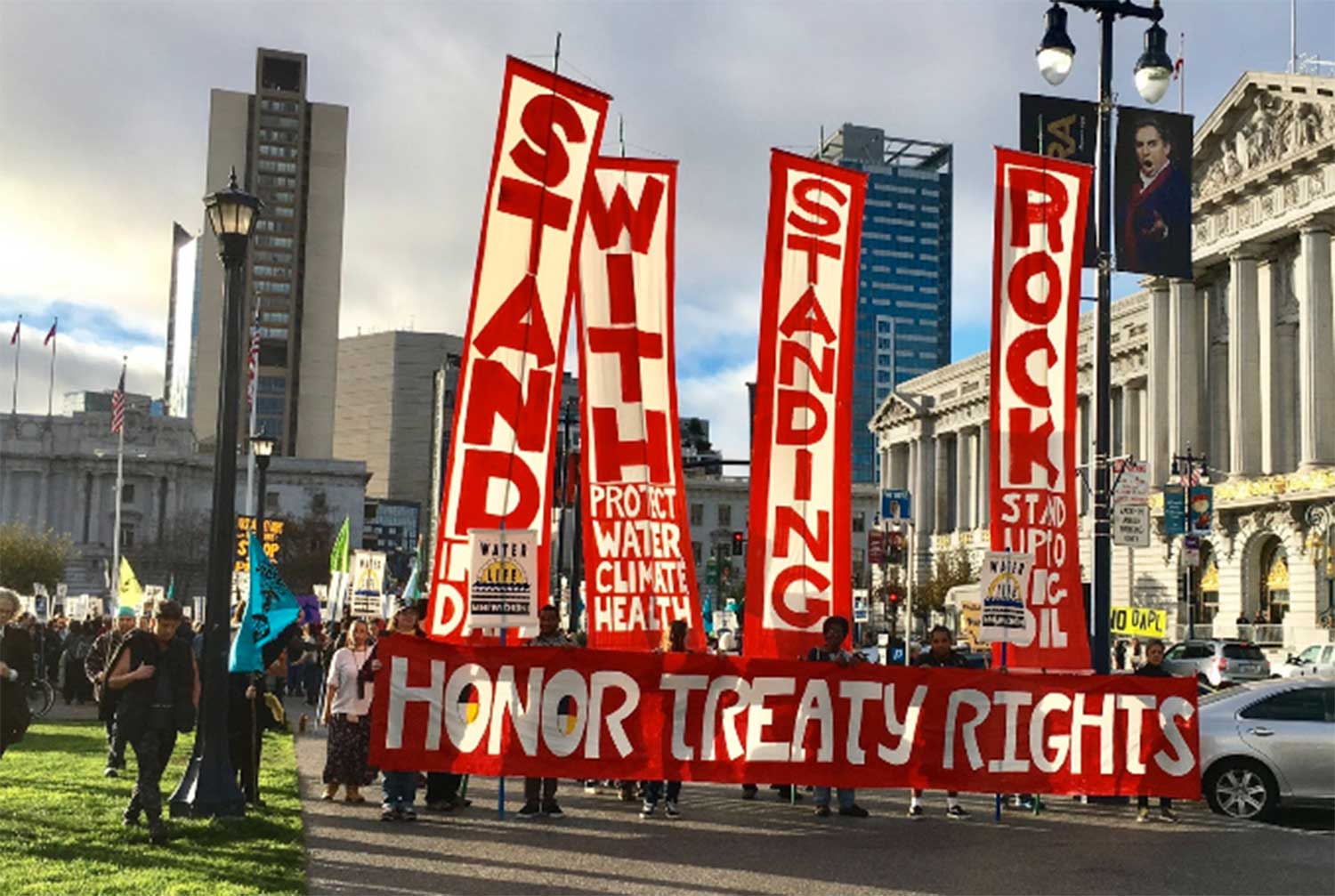
Bay-Area arts organizer David Solnit has been making art for protest movements for decades, and has established a practice of simple, reliable techniques for amplifying messages in the streets. I’ve condensed (and lightly edited and added to) a few of his resources in this blog post, and hopefully I’ll be following up with some more tips from David and other powerhouses of protest communication and props. These tips work really well with downloadable graphics from our graphics page here at Justseeds!
Our art and visuals can tell our story to those who see us or through media, make our actions more powerful, lift spirits and hold our space. It’s also a good way to involve folks, build momentum and have fun. Sometimes photos or even media coverage of an art build party can help get the world out. There are many ways to use images and slogans to get your message across.
COPY AND PRINT: download, and email to yourself or put on a flash drive and go to your printing place (like FedEx) or find out who you know who has a color printer or access to color printing. Make color copies (or black and white copies-depending on design) on 11×17 or 12×18 (if that is an option). It’s ideal if you can get cardstock or a heavy paper, or you can also mount them on cut-to-size posterboard/cardboard/etc using spray adhesive, glue stick, or tape around the edges.
ENLARGE AND ASSEMBLE: One way to make a larger sign is to enlarge  the design onto two sideways 11×17 sheets, cut and paste together on a rigid backing, to make one bigger 17×22 inch sign—or do it in 4 sections and make it even bigger.
ADD ELEMENTS: you can add a colored paper or painted border, use colored posterboard and leave a border, or add a not-too-dark color wash(watercolors or watered-down latex/acryic paints) to back and white designs.
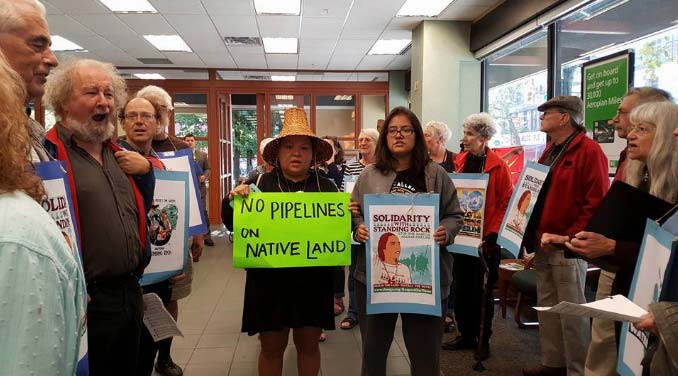
One great way to use images and slogans is to get them onto CROSSBAR FLAGS. 

These painted, stenciled or screen-printed fabric flags are designed to have horizontal sticks at top and bottom, and also attach to a vertical pole. They are very visible, and easy to carry.
Here’s how to make one–or many:
1) GET AND CUT FABRIC:
Choose a lightweight  muslin, cotton, polyester or other lightweight non-stretchy white fabric. White sheets are also good, and damaged ones can sometimes be had for free from industrial laundry companies. Cut–or tear after an initial cut–to size. I usually make these flags about 24 x 40 inches, allowing 6 inches to wrap around the top/bottom sticks. You can adjust the flag size to make best use the of size of fabric you have. One reason I choose a light fabric is so the light will shine through if the sun is behind the flag.
2) STAPLE/TAPE DOWN:
I create a painting table with a sheet of not-too-rough plywood placed on top of a table or sawhorses, and then staple the flag fabric to the plywood in four corners, pulling it tightly so there are no wrinkles. You can also do this with masking or duct tape.
3) DESIGN/LAYOUT: Draw your design — first on paper, then on the flag fabric. TIPS: Less is more; keeping to a few shorter words and simple bold images makes it stronger and easier to read. A light/dark contrast makes it readable. One option is to paint a light color over the whole flag, priming it, let it dry, then draw your design and paint with much darker colors.
Remember, the more complex your image, the more time it will take. Using a straight edge, mark the top/bottom edges of your words. If you need help spacing, count the number of letters in each line and dividing in ½ and ¼  guide for where they go on the flag.
4) PAINT: I paint flags and banners with latex (water clean up) house paint. You can also use artists acrylic paints. Don’t use tempera paint–it smears easily and runs if it gets wet. I put the paint into a plastic container and thin with water a bit to make it flow–easier to paint with, but not so much it bleeds or looks thin. Let the flag dry, then pull it off the plywood. NOTE: you can also choose to screen print or spray-paint stencil the flags, maybe adding a handpainted element too.
5) ATTACH TO STICKS
I use wood lath, narrow wood strips (1 1/2 x ⅓ inch) like was once used to back plaster walls and is now used for fence trellises. You can buy it either for fence lattice and garden trellis or for plaster walls. A clear (no big knots) 2×4 can be ripped on a tablesaw. But, you can use whatever you can get. Cut the stick an inch shorter than the fabric, so it’s not visible or sharp. Us a staple gun to staple the edge of the fabric to the outside edge of the stick. Roll the stick over twice and securely staple the fabric to the stick. Use ¼ inch staples–or just shorter that the wood thickness, to avoid sharp edges. Do this at the top and bottom. Then get your vertical flag pole; I usually use 8 foot tall,  1×2 inch “furring strips” making sure they don’t have big knots that might break while carrying. I get 3/4 to 1 inch washerhead screws, or wood or sheet metal screws, and use a cordless drill with a phillips bit to screw the middle of the top and bottom of the flag sticks securely into the vertical flagpole. I either assemble them onsite to make transport easier or else bundle them up 4 -6 per bundle for transport and carrying to site.
6) CARRY! Are they in the best place and facing the right direction? Do you want them to move as a line or groups of flags, or with some choreography? They can be a powerful visual positioned right behind a hand-held banner people hold below their heads.

There’s some further tips on how to make these flags and also how to paint GIANT BANNERS and more in this great 12 minute videofeaturing David and a crew of artists and activists at work.

Here’s a variety of forms of visual art that have been produced with groups for actions and demonstrations:

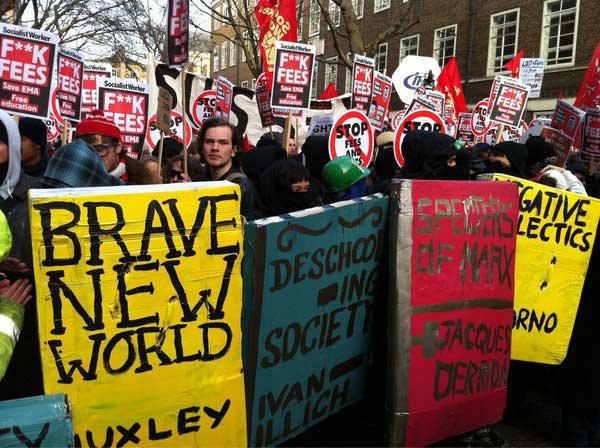
HAND HELD SIGNS: signs with a picket stick that people hold in their hands—these can range from 11×17 copied/printed to hand made, screen printed or printed cardboard, yardstick, fabric. Making them beautiful, colorful, visually strong, simple and including color and images can really help the event come more alive.
PICKET SIGNS: Any kind of sign on a stick or pole—cardboard or yardstick are most common. They can be made in the shape of a relevant image.
BANNERS: Fabric horizontal banners with printed words and or images can be hand held below head level or held overhand on two (or more for longer banners).
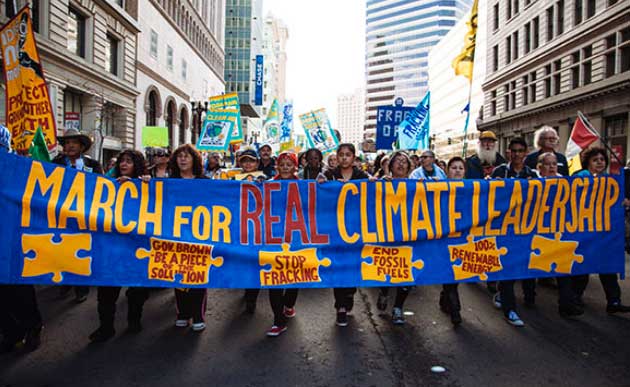
GIANT BANNERS: Long banners from 16 to 100 feet long have repeat images or messages or a long message and/or image. It takes more folks to hold and can be tough if windy, but can also really visually have an impact.
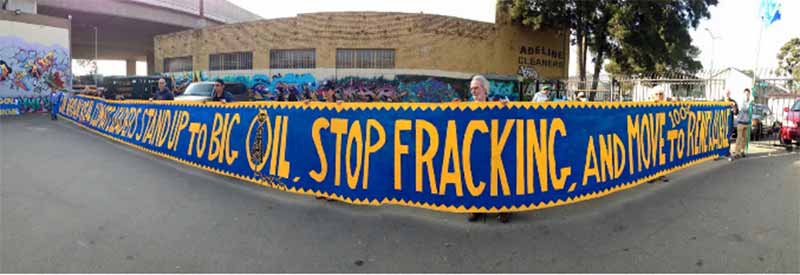
GIANT HORIZONTAL BANNERS: Wide and often long banners held horizontally so they are visible from above and at the side can help colorfully hold and occupy streets or space, be energizing for those carrying (put an earth ball in and it becomes a game of moving the ball around and trying to save it from falling out). These can make for great photos from above, or from underneath.
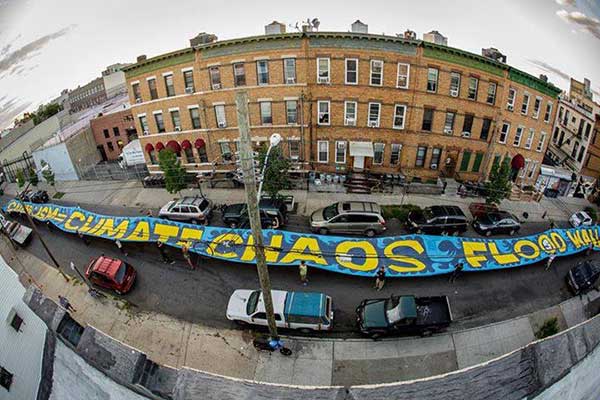
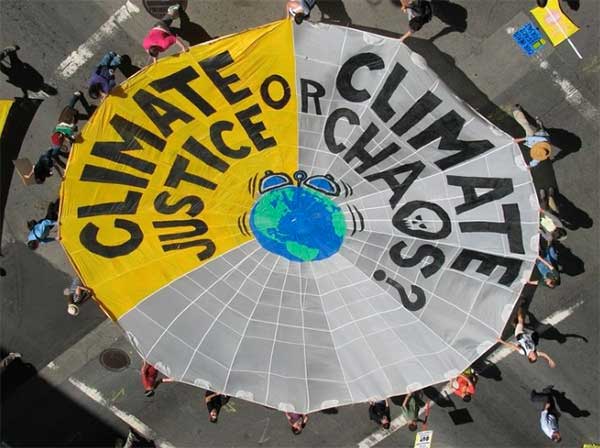
PARACHUTE BANNERS: messages and or images painted on a “play parachute” which come 12 or 24 feet on white nylon. Strong space/street occupying visuals and great for games (and for kids). Can offer a bit of sun/rain protection for those underneath.
VERTICAL BANNERS: like the “Crossbar Style Flags”, but bigger and often haunted on bigger taller poles—bamboo or wood. They can be very visible above the heads of a march or rally, but can also challenging in strong winds.
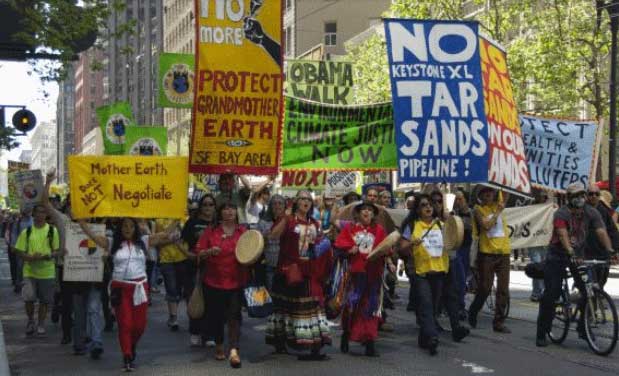
FLAPPING FLAGS: painted or screen printed, often on light nylon fabric or other fabric that catches the wind easily. They can be mounted on wood, bamboo or even telescoping-extending painting roller poles.
BIKE BLOCK FLAGS: Bikes can be adorned with flags (they always flap visibly when riding) to add a mobile and dynamic visual element. Bike flags can be painted or screen printed on fabric.
PUPPETS: Puppets can represent figures in the story being told—either a type of person or community or specific person or someone from history. Puppets can be very simple with just a head and poncho costume on a pole or a three person puppet with one person holding the body and head on a pole or wearing it on a backpack frame, and two others holding each hand. It’s worth thinking about who the puppet will represent, if you have the time to make it with care, if it will have an slogan and/or message on it and also to have the people operating it rehearse with it and maybe get into costume or wear a common color. The person carrying the puppet is the puppeteer and can bring it to life and make it more powerful if they are eager to perform. Groups of puppets can interact. Puppets representing different sides of an issue can struggle with each other. Be careful, however, not to let the puppet become more important than the protest! If they become a burden or an obstacle, get rid of them. Read more about the history of radical puppetry here.
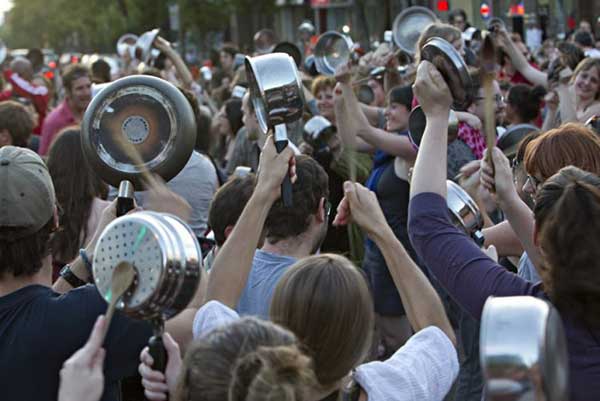
ACTUAL OBJECTS: Marchers carrying real sunflowers marching on an oil refinery. Teachers mobilizing to a school board meeting demanding a decent contract carrying actual shovels painted with the words “TEACHERS DIG DEEP,” “TEACHERS CULTIVATE.” Argentines, Icelanders and others have marched with everyday kitchen pots/pans and spoons as both noisemakers and household symbols of ordinary people. People commemorating a murdered activist carried roses to lay at an altar in front of the building of the institution that murdered the person. People carry actual household brooms and mops to tell Chevron Oil to ‘CLEAN UP” it’s mess. That actual object can often be more powerful than an artistic representation. The world of protest is your oyster!
SHIELDS: Sometimes you might need to defend yourself or your friends in a protest context. One protest used 3′ x 4′ scale models of book covers on thick, reinforced cardboard with handles on the back as both props to communicate good reading ideas and tools to defend against attack.
See you in the streets!

Tuesday, April 7, 2015

NYC officials remove Edward Snowden statue secretly installed in Brooklyn park


http://mashable.com/2015/04/06/snowden-sculpture-fort-greene-brooklyn/?utm_cid=hp-hh-pri

Snowden-sculpture
A sculpture of Edward Snowden stands atop a column in Brooklyn's Fort Greene Park on Monday, April 6, 2015.
IMAGE: AYMANN ISMAIL/ANIMALNEWYORK
NEW YORK — Dressed in reflective yellow construction gear while working under the cover of darkness early Monday, a small group of artists installed a tribute to NSA-leaker Edward Snowden in a Brooklyn park.
But it was gone by midday.
The Snowden bust stood atop a column at the Prison Ship Martyrs Monument in Fort Greene Park, a site built to honor more than 11,000 American prisoners of war who died aboard British ships during the American Revolutionary War.
The location was no coincidence.
Speaking to Mashable on the condition of anonymity, the artists said they chose the spot because it is "loaded with significance and meaning and reverence of others." It positions Snowden, they said, "as a continuation of a story that began at the beginning of this country" — one represented in the plight of the captured Americans.
Snowden Sculpture Full
A sculpture of Edward Snowden stands atop a column in Brooklyn's Fort Greene Park on Monday, April 6, 2015.
IMAGE: AYMANN ISMAIL/ANIMALNEWYORK
snowdenbust-apr6-5531
IMAGE: AYMANN ISMAIL/ANIMALNEWYORK
"We feel that Snowden's actions really continue that story," said the artists. "It is built upon a set of ideals to live freely, not be confined or surveilled or monitored by your government. You can’t have freedom of expression to pursue liberty if you feel like you're doing it under a watchful eye."
While others have created Snowden statues before, they've primarily been mobile installations. The sculpture that stood in Fort Greene Park was meant to be permanent. The artists had hoped the city would have considering leaving the sculpture where it was, but they were prepared for the inevitable.
A spokeswoman for New York's Parks Department told Mashable earlier in the afternoon that they were looking into the statue's removal. Shortly after that Vine's Jeremy Cabalona posted video of NYC Parks Department workers covering up the Snowden statue with a blue tarp.

By 2:40 p.m. ET, the statue was gone.
"Parks and NYPD have removed the sculpture," the spokeswoman, Maeri Ferguson, confirmed to Mashable. "The erection of any unapproved structure or artwork in a city park is illegal," she said, referring further questions to the NYPD.

The story behind the Edward Snowden statue

The three artists — two of whom who planned the idea while a third created the "museum-quality" sculpture itself — spent the better part of year on the project.
Their hard work paid off: Animal New York's Bucky Turco, who exclusively documented the installation Monday morning, said it looks so official that "over a dozen people walking their dogs passed by the new bust on Monday morning without noticing the unsanctioned piece."

While they originally considered other locations to install the sculpture — Belvedere Castle was one of them — they felt the Martyrs Monument offered them the best chance to convey the ideals that Snowden's revelations are all about.
Snowden Monument Google Maps
IMAGE: GOOGLE MAPS
"It gives the whole thing so much more meaning," they said. 
"It’s not just about Snowden. It’s about the ideals that he was trying to work towards and push others to care about."
"It’s not just about Snowden. It’s about the ideals that he was trying to work towards and push others to care about." The monument to the POWs, "who were fighting for the same ideals that Snowden is fighting for" gave them a bridge to make their case.
"This is a guy who some of the traditional mass media has portrayed as a traitor, or a terrorist, and the very same thing would have been said about these POWs in the Revolutionary War times," they said. "But with 200 years of perspective, we realized they were fighting for something all of us are very grateful for. We hope it will shift people’s perceptions, or open their eyes, that there could be a different story than what they’e been told."

Ideally, for the artists, the city would have preserved the statue and make it accessible to people, allowing New Yorkers to continue the conversation that began when Snowden leaked batches of NSA documents to Glenn Greenwald.
In a statement, they appealed to the city to "embrace and protect" the piece, much like the Wall Street Bull:
NYC has a long history of welcoming artists and the challenging discourse their works usher in. In keeping with this tradition, we hope New York will embrace and protect this piece, much as when the “Wall Street Bull” was granted a permanent public home after its guerilla placement. Even though it's already on it's way towards being removed, the possibility exists for the city to make the piece available for public viewing in a sanctioned way. Our additional hope is this gift has brought a renewed cultural relevance to the space, inspiring more visitors to ponder the sacrifices made for their freedoms and their responsibility to ensure our liberties last long into the future.
"If you look at history, the people we honor with statues now — certainly the people rebelling against the British rules — were criminals one day," the artists told Mashable. "Now they're heroes."
"We’re wondering if on the long arc of time Snowden will be considered a hero, too."
Have something to add to this story? Share it in the comments.

Wednesday, March 11, 2015

William Pope.L's on Artforum's Cover


Artforum, February 2015, featuring William Pope.L's Foraging (Asphyxia version) from the "Black Domestic Project" (1993-1995/2008)

Symposium: Art, Social Change, and the Urban Sphere + the Artist Dread Scott

Dread Scott, “On the Impossibility of Freedom in a Country Founded on Slavery and Genocide” (2014), photograph: Mark Von Holden Photography, project produced by More Art (courtesy of the artist) 
Many artists, students, educators, scholars, critics, historians, curators, and writers want to know: how can I make a difference and how can I do so while remaining relevant? City College of New York’s Art Department, with its belief in the power of the arts to exact change and dedication to making the arts relevant to all audiences, seeks to engage these questions and more at its symposium “Art, Social Change, and the Urban Sphere.”
Held in conjunction with the Grey Art Gallery’s exhibition,The Left Front: Radical Art in the “Red Decade,” 1929-1940, this symposium will bring together contemporary artists, curators, and writers to discuss socially engaged art in the urban sphere by asking panelists to respond to the question posed by the exhibition, “what could a revolutionary art be today?” For some, the will to produce a “revolutionary” art is perceived as a nostalgic leftist position. In other forums, radicalism is repackaged as mere “optimism” without any substantive political, critical, or theoretical platform. In light of the commodification of social practice, the critical debates regarding the viability of relational aesthetics, and the upsurge of community-oriented practices, this symposium asks: where do we stand today in terms of the possibilities and limitations of so-called socially engaged practices?
Participants will shed light on this topic and these questions through specific projects and interventions that broaden, complicate, and challenge our understandings of the “the public sphere” in relation to race, gender, queer politics, and state power. Artist and activist Dread Scott will speak about his recent art project on the streets of Harlem, “Wanted,” which addresses the criminalization of youth in America. Johanna Fateman, musician (Le Tigre), cultural critic, and writer, examines the feminist guerrilla performance collective, Pussy Riot, and her recent collaboration with this punk rock protest group. Multi-disciplinary artist Carlos Motta discusses Six Acts: An Experiment in Narrative Justice, a series of performative interventions in public squares held during the 2010 presidential elections in Bogotá, Colombia that propose narrative or aesthetic justice as an alternative approach to normative justice. Eva Franch i Gilabert, Executive Director and Chief Curator of the Storefront for Art and Architecture, will moderate. In addition to featuring work by these contemporary artists and writers about social change and the urban sphere, the symposium at CCNY seeks a philosophical and critical discussion regarding art, activism, and cultural production.
Art, Social Change, and the Urban Sphere will be held at the City College of New York in Compton-Goethals Hall, room 249 (140th Street and Amsterdam Avenue, Hamilton Heights, Manhattan) on Thursday, March 26 at 6pm.
The Left Front: Radical Art in the “Red Decade,” 1929-1940 continues at the Grey Art Gallery at NYU (100 Washington Square E, Greenwich Village, Manhattan) through April 4. 

Sunday, February 22, 2015

Jefferson Pinder's "Dark Matter"

Jefferson Pinder is an artist I met while we both lived in Washington, DC.  
His work amazed me then and it continues to inspire.

"DARK MATTER"
2014 
Featuring Lionz of Zion

"Under bright police lights, break-dancers dressed in black perform a series of actions that references the Ferguson events from August of this year. In this work  B-boys physically reference the actions from the murder that took place during August 9th and the ensuing riots. This performance pairs athletic movement with social struggle."


(Stills)