Tuesday, March 3, 2015

More on the suffragettes


Big Brother and the sisters

Police use covert surveillance to catch organised criminals, hooligans and speeding drivers. But it was introduced to fight a different menace - suffragettes. By Alan Travis
From http://www.theguardian.com/world/2003/oct/10/gender.humanrights

'March, march - many as one, 
Shoulder to shoulder and friend to friend'
- The March of the Women, battle anthem of the WPSU. Composed by Ethel Smyth, Holloway prison, 1911 
It is now common practice for police to hide a photographer in a van; and for closed-circuit television cameras to film the crowd at a demonstration or a football match in order to identify troublemakers later. But few know that these techniques of covert surveillance were first developed nearly a century ago by Scotland Yard to tackle the then novel direct-action tactics of the militant suffragettes battling for votes for women. The remarkable police mug shots on the right, taken in 1914, of 18 suffragettes who went to prison for the cause, also show that it was the police rather than the press who first developed the snatch tactics of the modern-day paparazzi. 
Some of the shots look strikingly modern, and the curious thing about most of them is that the women are not looking at the camera. This is because most were taken without their knowledge, using covert means inside prison. In one or two cases, the prison authorities tried to photograph them openly and the women tried to distort their faces so that the final result was less recognisable. 
The photographs were found in newly discovered Home Office files at the National Archives in Kew. They feature in a new exhibition to mark the centenary of the founding of the Women's Political and Social Union at the Manchester home of Emmeline Pankhurst 100 years ago today. 
The fight for women's votes had begun as early as 1832, when the Reform Act extending suffrage used the word "male" instead of people. Suffragist societies were established across the country in Victorian England, but by the early 20th century many women were disenchanted with the progress that had been made using their tactics of petitioning and letter-writing. Pankhurst, a member of the Independent Labour party, started the WPSU to adopt a more radical approach. 
In 1905 Emmeline's daughter, Christabel, was the first WPSU member to be imprisoned as a result of the unprecedented campaign of direct action. The Daily Mail in January 1906 dubbed the movement the "suffragettes" as a term of abuse, but the women turned it into a badge of pride. 
The protesters chained themselves to railings, sabotaged political meetings, clashed violently with the police and smashed windows - all of which led to banner headlines in the papers. Many women, and some men, went to prison for the cause; some of these went on hunger strike and suffered the brutality of being force-fed. But it was one of the later tactics in the Votes for Women campaign - their attacks on major works of art in April 1914 - that sparked the development of the paparazzi techniques by the police. 
The police special branch had already dedicated 16 officers full time to the task of following the activities of the WPSU, monitoring their meetings and telephone calls. They often tried to follow them but were soon asking the commissioner for motorcycles to help them keep up: "As soon as they are out in the country, they drive too fast for any conveyance that police officers can obtain. A motorcycle would perhaps make it possible to follow them. As a start one would perhaps suffice." 
The files show that in September 1913 the Home Office had ordered that the photographs of all the suffragette prisoners be taken without their knowledge. This was done because many of the women refused to have their pictures taken and, in an era when film speeds were much slower, this could prove fatal to the results. Early attempts to photograph the women from a distance while they took exercise in the prison yard did not prove a great success: "It cannot be regarded as a very satisfactory means of identification, but it is the best obtainable after several attempts. Shall I have them taken in the ordinary way? This of course could not be done without their knowledge," the police photographer asked Scotland Yard. 
The files include a remarkable picture of Evelyn Manesta (no 10), a young woman from Manchester, which shows what happened when they tried to photograph the suffragettes "in the ordinary way". She has the arm of a prison warder around her throat to restrain her and she is grimacing in an attempt to distort her face. The somewhat grotesque result was used in a wanted poster of Manesta circulated by Scotland Yard but the image was doctored to hide the warder's arm around her throat and the embarrassment of the police at their brutal treatment of the women. 
The response of the police to the suffragettes' non-cooperation tactics was to adopt the techniques of the modern-day paparazzo - a long lens and a concealed hiding place. The home secretary himself authorised the purchase of a Wigmore Model 2 reflex camera "to be used for the purpose of photographing suffragette prisoners". Scotland Yard's "convict supervision office" bought the special lens - a Ross telecentric lens costing the princely sum of seven pounds, six shillings and 11 pence. It could be attached to a snapshot camera and would "take satisfactory portraits of suffragette prisoners from a distance". A professional photographer, a Mr Barrett, was commissioned to take the pictures "concealed in a prison van" in the exercise yard in Holloway prison. 
The authorities were so worried that the suffragettes would learn what they were up to that Barrett was issued with codewords by the prison commissioners: "wild cats" for suffragettes and "New Varsity House" for New Scotland Yard. When Holloway prison called Barrett to take a picture, they would ask for the "photogram". The prison commissioner reported to the home secretary: "I met Mr Barrett and arranged for the taking of photographs of all suffragists this morning at the inclusive rate of 2l 2s 0d and 3/- an hour if he is detained more than two hours." 
The photographs came into their own after WPSU activists started a campaign of slashing paintings in art galleries in Manchester and London. In March 1914, Velasquez's Rokeby Venus was severely damaged when Mary Richardson attacked it with a meat chopper in the National Gallery, slashing it seven times. Richardson said at the time: "I have tried to destroy the picture of the most beautiful woman in mythological history as a protest against the government destroying Mrs Pankhurst, who is the most beautiful character in modern history. Justice is an element of beauty as much as colour and outline on canvas. 
"Mrs Pankhurst seeks to secure justice to womanhood, and for this she is being slowly murdered by a government of Iscariot politicians. If there is an outcry against my deed, let everyone remember that such an outcry is an hypocrisy as long as they allow the destruction of Mrs Pankhurst and other beautiful living women." 
Her attack led to a decision to circulate the mug shots to the galleries so they could watch out for "known militant suffragettes" among the visitors. The keeper of the Wallace collection wrote to the police special branch, asking if they could supply more copies "so that the whole of the watching staff may make themselves thoroughly familiar with the appearance of the persons concerned". 
The 18 photos sent to the Wallace collection were all of women who had been convicted of criminal damage, arson or conspiracy. Evelyn Manesta, who had been convicted for attacking pictures in Manchester art gallery with "laminate", was among them. 
The resistance of the suffragettes to being photographed was just one example of their campaign inside prison to be treated as political prisoners and not common criminals. A "Holloway" brooch on display in the exhibition, featuring the House of Commons portcullis intercepted by a prison arrow and designed by Sylvia Pankhurst, was given to every WPSU member who was jailed. It was regarded as the Victoria Cross of the suffrage movement. 
Pankhurst saw WPSU members as "soldiers in the war we are waging" and developed the more militant tactics of sabotaging political meetings, attacking public property and hunger-striking. These tactics brought notoriety and funds - meetings held to demand the release of hunger strikers could raise as much as £2,000. In June 1906, 30 suffragettes, many of them holding babies in their arms, clashed with the police outside the home of Herbert Asquith, then the Liberal chancellor of the exchequer. 
An account in the file records the violent arrest of one of them: "A policeman proceeded to strike her with his fist, and she accordingly slapped his face. The policeman came forward and pinioned her, taking her by the throat and forcing her backwards so that she became blue in the face. With that she kicked the policeman's shins, and was arrested." 
The first suffragettes chained themselves to the railings of 10 Downing Street on January 17 1908. One powerful advocate was Evelyn Sharp, whose pamphlet, Why Women Should Have the Vote, features in the exhibition. A full-time writer for the Manchester Guardian and a member of the Kensington WPSU, she was told by an anti- suffragist after one of her passionate speeches: "One could have sworn that you were a demure little imp of mischief who made the teasing of poor old cabinet ministers a fine art, and hugely enjoyed the row you raised." Another WPSU member, Una Dugdale Duval, the debutante daughter of a naval officer, sparked a national scandal in 1912 when she married Victor Duval, the founder of the Men's Political Union for Women's Enfranchisement, but refused to use the word "obey" in her marriage vows. 
The campaign of window smashing soon followed. Downing Street was the first to hear the sound of breaking glass and in June 1912 the suffragettes launched a major offensive, breaking the windows of 270 buildings in London's West End. 
"Window-breaking, when Englishmen do it, is regarded as an honest expression of political opinion. Window-breaking, when Englishwomen do it, is treated as a crime," wrote Pankhurst in her biography, My Own Story. 
At the outbreak of war in 1914, Pankhurst rallied the WPSU to the war against Germany and women went to work in the munitions factories and on the buses for the first time. When the war ended, the government gave women over 30 the vote, but it was not until the Equal Franchise Act of 1928 that it was given to everyone over the age of 21. 
· The March of the Women exhibition at the National Archives, Kew, London, opened this week and runs until December 31.

Monday, March 2, 2015

MAGIC AND POLITICS – THE IRRATIONAL AS STRATEGY FOR RESISTANCE at Skogen, Gothenburg, Sweden

MAGIC AND POLITICS – THE IRRATIONAL AS STRATEGY FOR RESISTANCE

Sat 7/3
13:00 - 23:00
Location
Skogen
IM SKOGEN
ANNIKA LUNDGREN, KANSLIBYRÅN & NIKLAS PERSSON
***********************************************************
13.00 – 18.00
WORKSHOP 
Lunch, workshop and discussion forum
Through a series of conceptual and practical exercises we undertake to develop new strategies for political resistance. The workshop and discussions depart from concepts such as the use of abandoned forms of knowledge, the populist politician as illusionist, the irrational as destabilizing element, everyday activities as rituals and the art of doing nothing in a production-focused society.
****
18.00 – 23.00
EVENING PROGRAM
Dinner
Artistic presentations by Annika Lundgren and Kanslibyrån
Socializing time & bar

JOIN FULL DAY PROGRAM BY SIGNING UP IN THE FORM BELOW 
INFO & TICKETS FOR EVENING PROGRAM (DINNER & ART) —> HERE
***********************************************************
FULL DAY SCHEDULE
13.00 – 14.00: Lunch
14.00 – 18.00: Workshop
14.00: introduction to the theme, to Annika Lundgren and to Kanslibyrån
15.00: practical exercises with Kanslibyrån
16.00: everyone: presentation of material (see below under Practical Information)
17.00: processing and discussion of the different perspectives presented throughout the day
18.00 – 19.00: Dinner
19.00-21.00: Presentations
Annika Lundgren and Kanslibyrån presents artistic work from the perspective of Magic, Irrationality and Politics.
21.00-23.00: Bar and socializing
PRACTICAL INFORMATION FOR THE WORKSHOP
Please read the digital text-compilation that will be provided by Skogen after registering
Please bring some material for our workshop – this can be text, film material, reflections, literature, ideas, images, objects, stories or other stuff somehow addressing or relating to the topic of the arrangement.
***********************************************************
KANSLIBYRÅN is an activist group and artistic institution created by the artists Per-Arne Sträng and John Huntington. The Bureau is fighting a battle in everyday life where rationality, obedience and effectiveness are questioned in both the private and in the public realm. Society is mainly built on rationality and obedience, as a consequence Kanslibyrån is promoting irrationality and defiance as important behaviors. Kanslibyrån is trying to pinpoint situations where resistance is possible. By being irrational, illogical or act on a whim or impulse, uncertainty is created, and this uncertainty makes way for new thoughts and ideas. The collaboration Kanslibyrån was initiated in 2007 and is an ongoing endeavor.
ANNIKA LUNDGREN is an artist who’s practice mainly consists in time and text base work such as performances, interventions, public arrangements, lectures and writing. A current project is Strategies of Magic – a series of magic shows that addresses the difference between trickery and actual political transformation and where the purpose is to reveal rather than disguise the means behind the manifestation. In The Stock Is Rising Lundgren initiates a levitation of the Old Frankfurt Stockmarket while Atomic Tour – City Of The Damned is a guided bus tour treating it’s audience to a political sci-fi narrative relating the rise of right wing populism. Annika Lundgren is also a professor of Fine Art at the Valand Academy, currently conducting a research project on the relationship between art and politics, supported by the academy research board. This discussion forum at Skogen is carried out as a part of this and is the very first in a series of many to come. It also constitutes the initial establishment of the Resistance Archive which is a central feature of Lundgrens research project.
NIKLAS PERSSON  is an artist and creative director based in Gothenburg, Sweden. With a background in object-centered performance his work is situated in the intersection of conceptual writing, typography and the production of situations—often through publications and other text-based objects. The subject matter and strategies used comes from a long-running interest in that which bridges the dichotomy serious-jokingly, and the relation between sacred-profane in everyday life. Visual language in public space and mundane objects (both contemporary and historical) often serve as a base for his work, whether it is as an artist or creative director; with communication strategy for artists and culture institutions or in the independent production of publications and public situations.

THE RESISTANCE ARCHIVE is a compilation of strategies, theories and other forms of thoughts on political resistance—serves to address if and how art can produce actual political change. In relation to the academic institution the archive investigate what can be channeled from institution to practice for direct and practical use in relation to politics. The source material for the archive comes from art and social science, as well as other (more or less institutionalized) fields within the humanities. The continuously expanding archive merge and cross-fertilize elements from diverse areas, and by performing these new strategies in the form of artworks, actions, seminars/discussions and other events we hope that new practices are formed that can be direct and transformative in a political context. Perhaps the gap between thought and action within both art and activism can be bridged by a new way of thinking about these fields and how the can function as one?

Prefiguration in Contemporary Activism: A CTIS/CIDRAL Workshop

Found at:
https://citizenmediamanchester.wordpress.com/forthcoming/past/workshop-december-2014/

4 December 2014

Organised by Prof Mona Baker, Dr Jenny Hughes and Rebecca Johnson
Please click here to see the videos and presentations from this event
Prefiguration, or ‘prefigurative politics’, involves experimenting with ways of enacting the principles being advocated by an activist group in the here and now, rather than at some future point when the conditions for the ‘ideal society’ have already been created, thus collapsing the traditional distinction between means and ends.
This workshop, featuring keynote speaker Marianne Maeckelbergh (Institute of Cultural Anthropology and Development Sociology, Leiden University, Netherlands), explored organisational and structural practices that prefigure activist principles and actualise them in the present. It also extended the definition of prefiguration to encompass experimentation in textual, visual and aesthetic practices.


Programme & Abstracts


Plenary Session
Dr Marianne Maeckelbergh, Institute of Cultural Anthropology and Development Sociology, Leiden University
‘The Prefigurative Turn’
Click here for video
Over the past few decades, ‘prefiguration’ as both practice and theory of social change has slowly come to occupy a central place in political struggles around the world. More and more scholars are exploring prefigurative politics in an attempt to understand what these approaches to social change might mean for social movements, contemporary politics, and for the types of social change we can hope for in the future. In the analyses of the movements of the 1960s and 1970s, prefiguration was closely linked to the notion of ‘cultural politics’. This allowed analysts to see a much larger set of social relationships as essential to creating meaningful political change. Critics, however, argued that prefiguration was not a viable strategy for ‘real’ social change because it emphasized interpersonal relationships and left political and economic structures untouched. This paper draws on two decades of participation in prefigurative movements, specifically research on the alterglobalization movement and the recent wave of assembly and occupation-based movements, to explore the day-to-day dynamics of prefigurative politics and offer some key points for reflection on the possibilities and problems of prefiguration as a strategic practice in ongoing struggles to transform democratic politics and capitalist economy.
Panel 1
Chair: Zakia Pormann
Dr Luke Yates, School of Social Sciences, University of Manchester
‘Legitimacy, efficacy and imagination: prefiguration and social movements’
2014-12-04 11.35.50
The notion of prefigurative politics relates to a plethora of terms and ideas including micropolitics, utopia, ‘counter-power’ and ‘new’ forms of political participation. Their use raises issues about alternative or heterodox practices or institutions, the politics of political action itself, and the relationship between the present and the future. Work which raises these ideas indirectly poses solutions to interrelated crises of legitimacy, efficacy and imagination on the political Left. The paper begins by reviewing key claims from this work in three sections, using examples from recent social movement mobilisations to illustrate the argument. First, I argue that dichotomies between horizontality and hierarchy, prefiguration and ‘strategy’, or ‘community’ and ‘organisation’ have led to unnecessary division and misleading rhetoric about political legitimacy. Secondly, ‘prefigurative’ modes of organising are limited in terms of efficacy, but are useful vehicles for building capacity. Thirdly, emphasis on existing projects, experiences, practices and institutions provide necessary optimism and ideas in the current absence of radically alternative political economic systems; but matters of linking and scaling up require renewed attention.
Dinithi Karunanayake, Centre for Translation and Intercultural Studies, University of Manchester
‘Prefigurative politics and the Open and Wayside Theatre in Sri Lanka’
2014-12-04 12.03.18
Prefigurative politics, which dismantle the classic distinction between the political goals of an activist group and the means by which they seek to achieve them, holds ‘the ends of political action to be equally important as the means, and has the intention (over time, or momentarily) to render them indistinguishable’ (Maeckelbergh 2009: 88). Taking the idea that ‘to prefigure is to anticipate or enact some feature of an ‘alternative world’ in the present’ (Yates 2014: 4) as a point of departure, this paper proposes to explore the manner in which the Open and Wayside Theatre, Sri Lanka’s first political street theatre group, embodies its politics in the formation of the troupe and the performance practices that it has evolved over its forty year history (1974-2014). The theatre practices of this troupe will be viewed in the context of two conflicts in Sri Lanka which span the major part of its postcolonial existence (1971 – 2009). Drawing on interview and archival data collected during a fieldwork trip to Sri Lanka in 2013 as well as selected performance texts, the presentation will dwell on how the group democratises theatre practices and cultural production through its own structuring which is non-hierarchical and based on a logic of solidarity, the choice of performance spaces and by providing access to a range of performance texts that its audiences, mainly comprised of lower middle and working class people in Sri Lanka, may otherwise not have access to. Accordingly, attention will be paid to organisational and structural features as well as the performative and aesthetic practices of the troupe that prefigure activist principles and actualise them in the present.
 Rebecca Johnson, Centre for Translation and Intercultural Studies, University of Manchester
‘“Iraq is the new black”: A case study in prefigurative activist hip-hop’
2014-12-04 12.32.46
This paper analyses from a socio-narrative perspective the official music video of the 2009 song ‘P.H.A.T.W.A’, by Canadian-Iraqi political rapper The Narcicyst (“Narcy”). Drawing a distinction between performative and constative forms of self mediation (Austin 1975), I will argue that the video is an example of performative social construction which is prefigurative of emerging epistemologies of the globalised era.
In the sociological version of narrative theory, narratives are considered constitutive, rather than simply representative, of reality (Somers 1994; Baker 2006). They are furthermore not restricted to verbal forms of expression. This being so, recent conceptualisations of affect and precarity in critical theory and cultural studies can be called upon to enrich our understandings of contemporary narrativity by illuminating public spheres (narrative environments) as “affect worlds” (Berlant 2011) where rational or deliberative modes of thought are exposed as increasingly inadequate, masking the precarious nature of many people’s lived identities. In this context, performativity becomes a key political tool for the creation of global communities of affinity for individuals whose identities and values are not accounted for by the dominant narratives of liberal democratic society.
In the case of ‘P.H.A.T.W.A’, I will demonstrate how the narrator-character of Narcy bridges the diegetic and non-diegetic worlds through his rap performance, using both music and humour to assert his identity in a form of ‘conscious individualism’ (Martin 2010) characteristic of the narratives of activist hip hop artists. In using his ontological narrative to critically and creatively engage with the War on Terror meta narrative, Narcy affectively connects with others in a similar position of precarity and enacts breach of the normative epistemological structures of the hegemonic political order, thus prefiguring alternative modes of social engagement and thought.
Panel 2
Chair: Rebecca Johnson
Paula Serafini, Department of Culture, Media & Creative Industries, King’s College London
‘The Politics of Art Activism: Performance, Institutions, and Prefiguration’
2014-12-04 14.01.35
In the study of activism and social movements, prefiguration is seen as the creation of a future through present social relations (Sitrin 2006). This concept has been developed recently, for instance, in relation to the alter-globalisation movement and to Occupy, which embody in their everyday practices the same principles of democracy, openness, and tolerance they advocate for in an ideal future society (Maeckelbergh 2011). But instances of prefiguration can also be found in activist artistic practice, as open collective performances and artistic projects put into action values and ideals akin to a horizontal post-capitalist form of social organisation.
In this paper I will look at the politics of art activism in the fight against oil sponsorship of the arts in the UK. Groups like Liberate Tate, Shell Out Sounds and Reclaim Shakespeare Company have in the last few years repeatedly invaded and intervened cultural institutions in London, denouncing the dirty links between the arts and the oil industry, and demanding the end of sponsorship deals that greenwash Big Oil’s public image. These artistic actions have contributed to making the debate on fossil fuels and art sponsorship more visible, and have even succeeded at affecting the links between oil companies and certain arts institutions. In addition, the participatory and interventionist nature of these actions has challenged certain cannons of artistic practice, using art spaces in unconventional ways, and putting forward values and processes that differ from the art world’s prevalent norm.
Taking this into account, I will explore the creative processes and strategic choices of these activist performances in order to answer the following questions: what is the potential for prefigurative politics in creative actions against oil sponsorship? Furthermore, looking specifically at the artistic processes that challenge institutionalised norms, I will move on to ask: can these actions be seen as enacting prefigurative politics of social relations and artistic practice, despite this not being their primary objective? In order to answer these questions I will refer to instances from my ongoing ethnographic research, which focuses on the politics of contemporary art activism in the UK.
Dang Li, Centre for Translation & Intercultural Studies, University of Manchester
‘New Media Practices among Chinese Youth: a prefigurative culture in the making’
2014-12-04 14.30.55
The concept of prefiguration has been most commonly applied in reference to radical political moments characterised by non-hierarchical, decentralised organisational structures that emphasise participatory democracy through consensus decision making processes (Boggs 1997, Maeckelbergh 2011). In the Chinese context, where offline public organising and protests are risky and more likely to be suppressed and online discussions about sensitive political subjects are heavily censored, online communities organised around mundane topics such as pop and media culture can offer an important entrée for exploring prefigurative politics not only as overtly ‘political’ activity, but also as everyday practices that seek to “integrate personal and ‘lifestyle’ issues into politics” (Boggs 1997: 119).
Focusing on one type of apolitical networks – namely zimuzu (i.e. online communities that produce and distribute Chinese subtitles for foreign media products) – formed by ordinary Chinese youth, this presentation examines how mundane online interactions can transform into more complex and community-oriented actions through prefiguration. In particular, it looks at how participants in such networks make use of the cultural and technical resources available to them as they make sense of themselves and their daily co-creational experiences, all of which have fostered a new set of values around self-expression, openness, and altruism. Most notably, these values originate from pursuing personal interests, not from enacting political and social change, during ongoing online interactions with disparate (yet likeminded) individuals. In doing so, participants are transforming their networks into inclusive communities based on trust and solidarity outside of authoritarian institutions and exclusive guanxi[1] networks; and slowly accumulating skills and values necessary for a civil society. Contrary to popular claims that activism defines and motivates Chinese Internet users (Yang 2009), this presentation attempts to show that users, particularly the post 80s and 90s youth, turn to the Internet as a prefigurative space for mutual exploration and expression of shared interests and identities.
[1] At its most basic, guanxi (关系) refers to the notion that personal relationships are built through favours.
Dr Jenny Hughes, Drama, University of Manchester
Theatricality, gesture and protest: the ‘figure’ in prefiguration in contemporary activism 
2014-12-04 15.00.11
This aim of this paper is to open up a conversation about the ‘figure’ in prefiguration and contemporary activism, by examining two extraordinarily potent gestures from recent protests. The current wave of demonstrations that followed the shooting of a young black man, Michael Brown, by a white police officer in Ferguson – a suburb of St Louis (US) – in August of this year, feature protesters holding their arms in the air and chanting ‘hands up, don’t shoot’, an emotive embodiment of the reported final stance and words of Michael Brown. More than a year earlier and six thousand miles east of Ferguson, after the violent eviction of demonstrators occupying Taksim Square in Istanbul, Erdem Gündüz – a professional choreographer and dancer – stood silently for more than eight hours. His gesture of standing quickly attracted the interest of broadcast and social media, and within hours Gündüz was joined by hundreds of others, standing still in the square. It has become axiomatic to state that protest draws on the communicative potency of theatricality and performance as a tactic and strategy. My aim here is to draw on theories of gesture in theatre studies and political philosophy to examine how theatrical gestures might figure modes of subjectivity and relation that provide new perspectives on activism as a prefigurative domain. As Josette Féral has commented, ‘theatricality’ arises with the actor intervening in everyday time and space in ways that generate ‘a cleft in the quotidian that becomes the space of the other, the space in which the other has a place’. This paper draws on Féral’s proposal, alongside Marcel Mauss’s essay, ‘Techniques of the body’ (1935), Giorgio Agamben’s ‘Notes on Gesture’ (2000), and Brian Rotman’s notion of the ‘gesturo-haptic’, to argue that theatrical protest gestures rehearse and prefigure modes of ‘being besides ourselves’ in a world where there is no place to stand outside.
References
Giorgio Agamben (2000) Means without end: Notes on gesture, Minneapolis & London: University of Minnesota Press
Josette Féral (2002) ‘Theatricality: the specificity of theatrical language’ SubStance, 31: 2 & 3, 94-108.
Marcel Mauss (1992 [1935]) ‘Techniques of the body’ in Jonathan Crary and Snaford Kwinter (eds.) (1992) Incorporations, Cambridge, Massachissetts: MIT Press.
Brian Rotman (2008) Becoming beside ourselves: the alphabet, ghosts and distributed human being, Durham & London: Duke University Press.
Panel 3
Chair: Dr Jenny Hughes
Mathijs van de Sande, KU Leuven
‘The Politics of Free Time: Prefiguring a New Time Regime’
2014-12-04 16.05.37
From classical political philosophy onward, politics has often been closely related to a certain notion of ‘free time’. Political action, or engagement in the public sphere, presupposes that one has a certain extent of free time at one’s disposal. It is the activity reserved for those spaces and moments in which – or persons for whom – the maintenance or reproduction of ‘bare life’ is not at stake, so that the engagement with public affairs can be truly disinterested. To put it stronger: this intimate relation between political action and free time is commonly understood to be at stake in politics itself.
Hannah Arendt critically distinguishes action from work, counterposing the instrumentalism of the latter to a radical conception of freedom closely identified with the former. Freedom is not the end or means, but “rather the substance and meaning of all things political.” Autonomist Marxists like Antonio Negri or Harry Cleaver argue that political action consists of the very process of subtraction from the capitalist relations of production and the time lost in it. Jacques Rancière shows how many historical and contemporary examples of political action must be understood as attempts to withdraw from dominated time and thus to reclaim control over it.
The global wave of protest movements that the world has witnessed in the past years is often understood to revolve around the occupation and recomposition of public space. In the tent camps of Tahrir Square, Zuccotti Park, Puerta del Sol, or Gezi Park (to name but a few), alternative forms of political organization and relations of production and property were prefigured. But the subtraction and creation of free time – neither as a precondition for politics nor as its end or outcome, but rather as its very matter – is equally fundamental to these prefigurative movements and practices.
A lot is to be learned from these recent movements and the ways in which they prefigure new time regimes. Through strategies such as precarization and flexibilization, neo-liberalism continuously colonizes – and, thus, depoliticizes – our free time. This increasing pressure for our everyday lives to be more productive, efficient, and flexible in all its aspects must be met by a politics of free time.
Sian Rees, Theatre & Performance department, Goldsmiths, University of London
Prefiguration at Burning Man – ‘Fleeting Intimations of a Better World’
2014-12-04 16.34.35
This paper considers the efficacy of Burning Man as a form of prefigurative practice for activists. Burning Man shares values prevalent within social movements; lived experience of participatory culture, sustainability (Leaving No Trace), radical self-organization and challenging commodification through ‘gift’ economy. Accordingly, many activists attend (Code Pink, Reverend Billy). It provides opportunities for activists to experience prefiguration in an immersive, safe environment, removed from some of the constraints of more public protest settings. Activists experience an alternative horizontal societal model, without the pressure of securing immediate impacts on policymaking or fearing police intervention.
Furthermore, Burning Man plays a multi-faceted role in making activism more sustainable. As a Temporary Autonomous Zone, Burning Man offers activists celebration, respite and sanctuary. It also provides a site for activists to reflect, share tactics, strategies and training. As a mode it embodies activist principles, but also provides inspiration and hope through the currency of creativity and imagination. Burning Man creates a utopian performative for activists to ‘share experiences of meaning making and imagination that can capture fleeting intimations of a better world.’ [1]Furthermore, in bringing together 66,000 people in extreme desert conditions, it provides a model where determination and collaboration render the seemingly impossible possible.
Crucially, Burning Man’s activities have extended beyond the Temporary Autonomous Zone into ongoing protest action. For instance, Burners without Borders [2], a community initiative to re-build infrastructure, was borne from the festival. Installations such as Burn Wall Street[3] served a dual purpose; bringing activism to the forefront of the festival, while also sparking critical debate “back home”, as mainstream media reacted to the controversial image generated.
Overall, Burning Man offers activists opportunities to practice prefiguration whilst helping to sustain future social movements, practically and ideologically. Significantly, it embodies resistance through the mode of cultural experience; collective action, creativity and celebration.
[1] Dolan, Jill, 2005, Utopia in Performance, University of Michigan Press, p.2
[2] Burners Without Borders, 2005
[3] Von Danger, Otto, Burn Wall Street, Occupy Black Rock, 2012
Conference Close – Professor Mona Baker
2014-12-04 17.07.30

Civil Rights Protests-arm over arm

Protest at the Dallas Country Courthouse in Selma, Alabama, 1965
© Bettmann/CORBIS. 

March on Washington for Jobs and Freedom, 1963


© Leonard Freedpublished by Getty Publications


Sunday, March 1, 2015

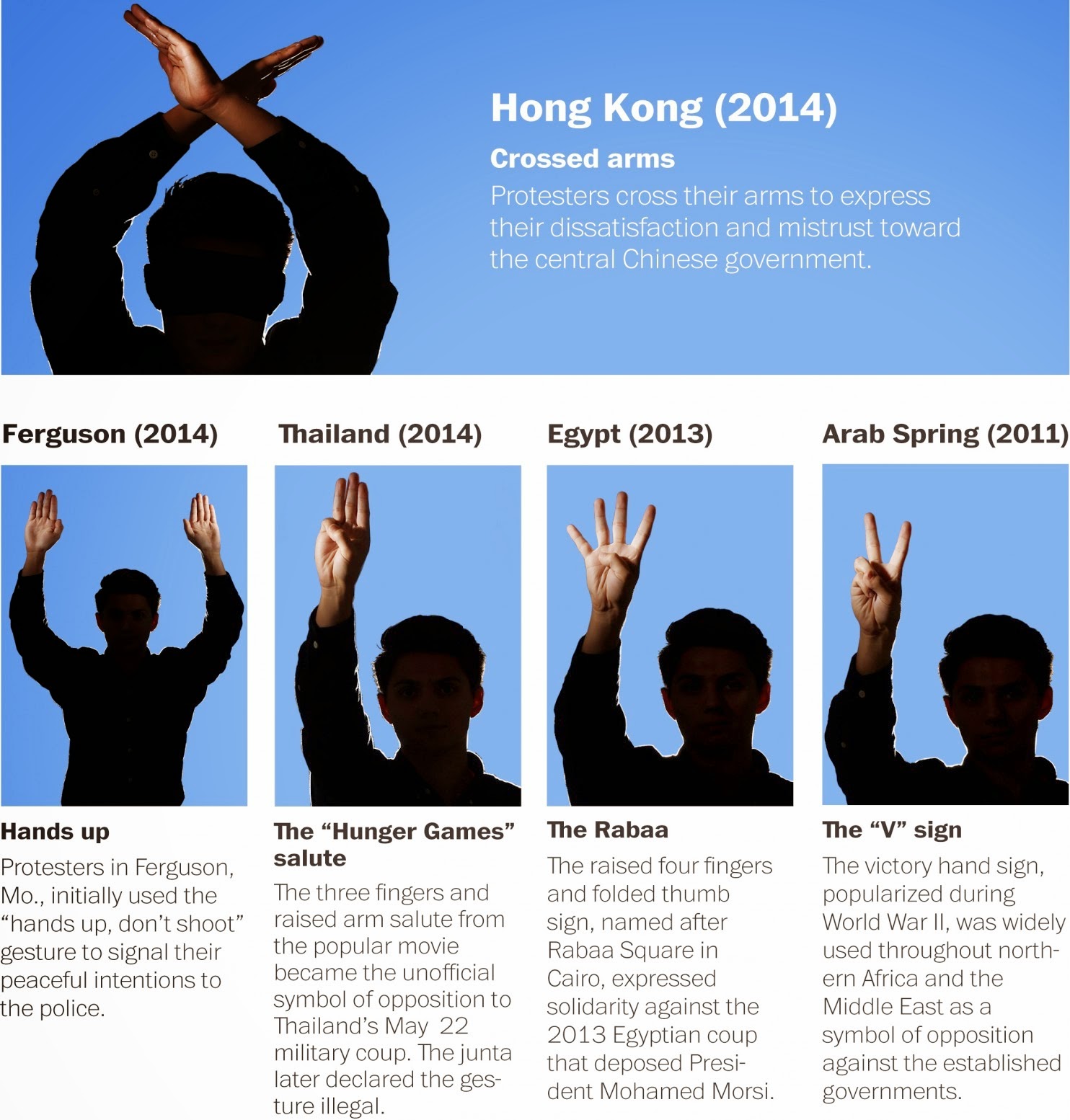
Protest Gestures


(Graphic by Alberto Cuarda and photos by Matt McCain / The Washington Post)

 October 2, 2014

Hong Kong’s crossed arms and other protest gestures around the world

When pro-democracy protesters took to the streets of Hong Kong on China's National Day this week, many silently turned their backs as the Chinese flag and the Hong Kong flag were raised. As they did so, they made a symbol with their hands – a simple cross, held above their heads.
These crossed arms, like the umbrellas that earned the movement the nickname the "Umbrella Revolution," seem to be special feature of Hong Kong's protests, but they follow a familiar pattern. In recent protests as far-apart as Missouri and Bangkok, protesters have used gestures to signal both their defiance of authority and their unity with other protesters.
In the Ferguson protests that erupted over the Summer, for example, many Americans threw their hands up directly above their heads – "Hands up, don't shoot" they would cry, a reference to witness reports that said teenager Michael Brown appeared to be surrendering before he was shot dead by a police officer. (Protesters in Hong Kong have also been seen adopting a similar pose, though whether this is happenstance or mimicry is a matter of debate.)
Other examples abound. In Thai protests earlier this year, protesters copied a three-fingered salute used in hugely popular dystopian book film "Hunger Games" to defy a tyrannical government.
And in the Arab Spring, many protesters used the more familiar two-finger "peace sign," first used to represent victory during World War II and later used by anti-war activists. Later, some in Egypt began to use a four-finger sign, known as the Rabia sign, to protest against Abdel Fatah al-Sissi's ouster of President Mohamed Morsi.
Some protesters have even gone so far as to use hand gestures as language. During the Occupy Wall Street movement, protesters used hand gestures to facilitate collective decision making.
In Hong Kong, however, the crossed arms seem to serve a simpler purpose. "We crossed our arms because we want to express our dissatisfaction toward the government, to reflect our mistrust towards the central Chinese government, and to object to the National People's Congress decision on August 31 [to only allow Beijing-approved candidates in an upcoming election]," student leader Joshua Wong later told CNN.
http://www.washingtonpost.com/blogs/worldviews/wp/2014/10/02/hong-kongs-crossed-arms-and-other-hand-gestures-of-defiance-around-the-world/
Adam Taylor writes about foreign affairs for The Washington Post. Originally from London, he studied at the University of Manchester and Columbia University.

Native American Council Offers Amnesty to 240 Million Undocumented Whites

"The Native American National Council will offer amnesty to the estimated 240 million illegal white immigrants living in the United States.
At a meeting on Friday in Taos, New Mexico, Native American leaders weighed a handful of proposals about the future of the United State’s large, illegal European population. After a long debate, NANC decided to extend a road to citizenship for those without criminal records or contagious diseases.
“We will give Europeans the option to apply for Native Citizenship,” explained Chief Sauti of the Nez Perce tribe. “To obtain legal status, each applicant must write a heartfelt apology for their ancestors’ crimes, pay an application fee of $5,000, and, if currently on any ancestral Native land, they must relinquish that land to NANC or pay the market price, which we decide.
“Any illegal European who has a criminal record of any sort, minus traffic and parking tickets, will be deported back to their native land. Anybody with contagious diseases like HIV, smallpox, herpes, etc, will not qualify and will also be deported.”
European colonization of North America began in the 16th and 17th centuries, when arrivals from France, Spain and England first established settlements on land that had been occupied by native peoples. Explorers Lewis & Clark further opened up western lands to settlement, which ultimately led to the creation of the Indian reservation system.
Despite the large number of Europeans residing in the United States, historical scholars mostly agree that indigenous lands were taken illegally through war, genocide and forced displacement.
Despite the council’s decision, a native group called True Americans lambasted the move, claiming amnesty will only serve to reward lawbreakers.
“They all need to be deported back to Europe,” John Dakota from True Americans said. “They came here illegally and took a giant crap on our land. They brought disease and alcoholism, stole everything we have because they were too lazy to improve and develop their own countries.”"
http://cityworldnews.com/native-american-amnesty/