Showing posts with label gay. Show all posts

Sunday, April 12, 2015

'Praying the gay away': Trauma survivors crusade to ban conversion therapy

REBLOGGED FROM:  http://www.theguardian.com/world/2015/apr/11/survivors-crusade-conversion-therapy-ban-pray-gay-away?CMP=fb_us

'Praying the gay away': Trauma survivors crusade to ban conversion therapy

 in Houston

When his father’s attempts to beat the gay feelings out of him failed, 11-year-old Sam Brinton was sent for conversion therapy.
“I was told I was the only gay left in the world, that the government had killed all the gay children, that I had Aids, that God hated me – a horrifying battery of lies which I had no reason not to believe because these were the people that were supposed to be helping me,” Brinton said.
Then came the physical torture: forcing his hands into ice while showing him pictures of men touching men, wrapping his hands in coils that heated up painfully when he saw images of men hugging, showing him gay porn and giving him electric shocks.
Several suicide attempts later, Brinton, the son of Southern Baptist missionaries, realised he had only one viable option if he wanted to carry on living. 
“In the end I had to lie and say I was cured just to get out of it,” he said.
Brinton doubts he will ever completely be free of the trauma. “I’m definitely still processing. The hard part is because it happened long ago, a lot of it is mentally associated into my cognition. Therefore, every single time I shake a man’s hand or get a hug, I’ll have a small amount of shock hit me. 
“It’s not that bad anymore, but I will probably bear the mental torture marks of conversion therapy for the rest of my life.
“The hardest part was that I was trying so hard to change. Every night I was praying with every ounce of my body, trying to figure out a way to actually change so that the pain would stop. You definitely think that something’s wrong with you and that if you try hard enough you can beat it.”
Like many other activists, Brinton was delighted when the Obama administration issued a statement on Wednesday night calling for a ban on conversion, or so-called reparative, therapy on minors. The White House’s action came in response to a petition inspired by the death of a transgender teenager from Ohio, Leelah Alcorn, who stepped in front of a tractor-trailer one night last December. Her suicide note referred to visits to Christian therapists who told her she was “selfish and wrong”.
Conversion therapies that try to turn gay people straight have been widely discredited. According to the American Psychological Association, “the most important fact about these ‘therapies’ is that they are based on a view of homosexuality that has been rejected by all the major mental health professions” – that it is abnormal, unnatural, and a mental illness that can be corrected.
New Jersey, California and the District of Columbia have banned the practice on young people, yet it remains widespread and attempts to make it illegal in numerous states have floundered, most recently in Colorado, just a few hours before the White House took a stance.
In 2012, four gay men launched an ongoing lawsuit against a conversion therapy centre in New Jersey, claiming they had been put through humiliating and harmful exercises such as stripping naked in front of a mirror and holding their penises, beating images of their mothers and squeezing two oranges that represented testicles.
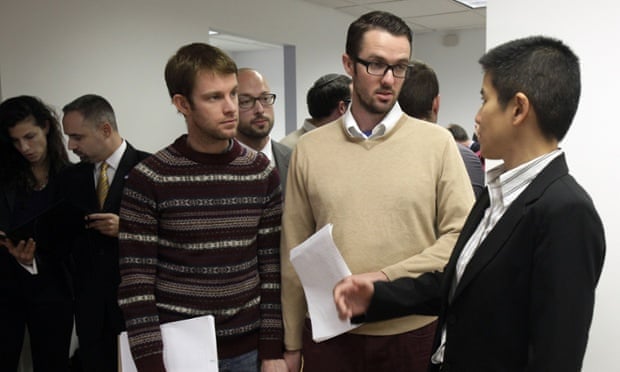
conversion therapy lawsuit 2012
Pinterest
 In 2012 Michael Ferguson, centre, was one of the four gay men making allegations against a New Jersey centre that did conversion therapy. Photograph: Richard Drew/AP
Samantha Ames, staff attorney at the National Center for Lesbian Rights (NCLR), said research indicated that as many as a third of LGBT people have undergone some form of conversion therapy – from seeing licensed practitioners, talking with church leaders or visiting religious camps to extreme versions which can include nausea-inducing drugs, needles in fingers and “orgasmic reconditioning”.

‘Obviously our president doesn’t know anything’

David Pickup, a licensed family and marriage therapist who works in Dallas and Los Angeles, said he and others offer a legitimate service and will lobby against attempts to outlaw it. He said the reputation of reparative therapy has been tarnished by “quacks” offering “junk” such as attempts to “pray away the gay” and shock tactics.
“Obviously, our president doesn’t know anything, or very little, about the nature of homosexuality for some individuals, knows very little about the scientific and anecdotal evidence that indicates that sexuality is changeable and that it’s not something that’s naturally inborn,” he said.
“People who are gay don’t have a disease, they are not mentally ill, nothing like that, but the research shows that sexuality tends to be rather fluid and especially for individuals who during childhood have been sexually abused by same-sex pedophiles, whose sexual feelings have come up because of these incidences. It’s an egregious error to say those little kids who are grieving and confused can’t get therapy to reduce or eliminate their same-sex attractions.”
Last year, the NCLR launched a campaign, Born Perfect, which aims to have the practice banned across the US within five years. 
“This industry is absolutely not going down without a fight. They are as strong and as determined and as destructive as ever,” Ames said. “This is not just like any other LGBT issue; this is really about the health and safety of our children.
“What we hear time and time again from survivors is that, as barbaric as these techniques can get, it is not the techniques themselves that are most damaging. What is most damaging across the board is the purpose of those techniques – to change the core identity of who a person is.”

‘It was just killing me’

Advertisement
When Bryan Christopher took an elevator to the top of the Empire State Building 15 years ago, he was not looking forward to admiring the view. He was thinking about throwing himself off. Born in 1970 and brought up by conservative parents in Waco, Texas, he spent more than a decade hiding his sexuality and undergoing conversion therapy.
“Growing up in the 80s and 90s, there weren’t any voices around me that were saying it was OK to be gay,” he said. “My crusade to change went through many different twists and turns and it ultimately did lead me to ex-gay conversion therapy. 
“At UCLA I joined the fraternity, thinking that would set me straight, and I worked as a butler for Hugh Hefner at the Playboy mansion, thinking that would set me straight. Ultimately it came to the point where I realised: if I’m going to change, then I need a miracle and I need to seek out God, and really do everything I can to heal what I’ve been taught is broken. To fix it.”
In his 20s, Christopher took anxiety medication and sought help from a psychotherapist and Christian mentors. 
“The turning point was right after college when I called a Christian suicidal hotline and put myself into a psychiatric hospital for 72 hours,” he said. “I was 24 and I hadn’t changed and was strangely in love with a fraternity brother who ended up becoming a high-profile basketball player at UCLA. 
“It was just killing me. My heart was wanting one thing and my mind and all the voices around me were telling me no, it’s a sin, it’s a sickness. Even with a degree in psychology from UCLA, where I learned that it’s just a normal variation in human sexuality, I still discarded all of the medical conclusions and I still felt I could change.”
Christopher ended up seeing an “ex-gay” California-based Christian reparative therapist, who told him that homosexuality had root causes – perhaps a weak father and a strong mother, rejection by classmates, or liking art but not sports. 
“None of that was true for me,” Christopher said. “I had great parents, I had friends, I was never the excluded one, I was popular in high school. I led a very heterosexual life. You don’t get more heterosexual than the Playboy mansion and a fraternity.
“They used the disease model of alcoholism to draw parallels. So when I asked him, I said point blank: ‘Do you still have gay inclinations or desires?’ he said that he monitors the events in his life, where he goes, who he’s around, so he never puts himself in a situation where he’d be tempted, much like an alcoholic doesn’t go to a bar.”
Christopher finally realised that his struggle was futile and self-destructive. “It’s a form of soul torture, really, especially when you do it as long as I did. And no one forced me into it. I went into it willingly because I was a true believer. I thought this was something that could be cured.” 
He now lives in Minnesota with his partner, works in real estate and has written a memoir, Hiding from Myself.

‘If you think about it, we’re double-trapped’

Brinton, now 27, works for a think tank in Washington, advising politicians on nuclear issues. “Many of my fellow survivors of conversion therapy have died of suicide,” he said. “I know of dozens that have died and it’s horrifying. 
“If you think about it, we’re double-trapped. We can’t got back to therapists because they’re the ones who ‘hurt’ us in the first place. So our mental health access is extremely limited.”
Last year, Texas Republicans adopted a platform backing reparative therapy “for those patients seeking healing and wholeness from their homosexual lifestyle” and stating no laws to prohibit it should be introduced. 
This year, Celia Israel, an openly lesbian Democratic state representative in the Austin area, introduced a bill to ban reparative therapy for minors. She does not expect her bill to become law, but wanted to make a point. 
“I thought it was important to introduce the bill to make a statement that this should not be accepted practice any more,” she said. “They don’t need to be ‘fixed’; they just need to be loved.”

Monday, March 9, 2015

Fire Island Artist Residency

Residency Deadline: April 1st 2015

Fire Island Artist Residency (FIAR), the first residency in the United States exclusively for artists identifying as lesbian, gay, bisexual, transgender or queer, is now accepting applications for its prestigious and internationally recognized summer program. Now in its fourth season in the secluded community of Cherry Grove, NY, an historic LGBTQ settlement of Fire Island, five emerging artists will share a live/work space for a four-week program marked by intimate studio visits with, and public lectures by, renowned leaders in contemporary art and curation.

=====================================

Last summer, about halfway through the inaugural two-week long Fire Island Artist Residency (FIAR), a program exclusively for LGBT artists, locals from the island along with a few transplants from the city gathered at the house the group had rented on Cherry Grove. The range of guests included intrigued summer tourists, young artists, New York curators and a reporter from Fire Island’s local paper, wearing leather short shorts, a leather vest and not much else.
“You looked out on this room and there was a total head-to-toe leatherman who smelled like pee standing right next to [the curator] Dan Cameron,” said Chris Bogia, in his office at NYU’s Steinhardt building on Ninth Street. Mr. Bogia is co-founder of FIAR with Evan Garza, a writer and curator in Boston (he joined in an interview with The Observer via Skype). “I was like: ‘This is exactly what I wanted!’”
“There were legendary queer artists on Fire Island,” Mr. Garza said. “People like Mapplethorpe and Peter Hujar. Writers like Tennessee Williams and W.H. Auden. There’s a total absence of those people now and I think it’s so important for us to put artists back in that environment, just to see what happens to their work.”
“This confluence of culture,” Mr. Bogia cut in, “it’s not just about these hip artists going out there and hanging out in this house and being dirty art hippies.” He paused. “It is about that, but it’s also about pulling in the community. Because it’s just disco out there right now, and it is crazy to me that that’s still the major attraction.”
They say disco was invented on Fire Island, at the nearly mythical dance club Pavilion, which was destroyed by a fire last month. The large wooden structure was built in the 1950s and purchased by the model John B. Whyte in 1966. Drinking would start early in the evening; things would get rowdier, and sweatier—the place didn’t have the best air-conditioning system—as the night wore on. AA meetings are also big on Fire Island.
There are two sections to this particular stretch of Long Island that are, more or less, separated by class: the wealthier Pines community and the younger, scrappier Cherry Grove (the literal dividing line is, in the words of one resident, “a sex forest” called the Meat Rack). It has been a lot of different things over the years. The Fire Island Lighthouse, a historical landmark, used to be the first thing ships would see as they sailed into New York harbor. Before the lighthouse was built in 1858, shipwrecks were so frequent that the Fire Islanders of the day would camp out on the beach and live off of the wares of some poor marooned ship (usually after killing the whole crew). Frank O’Hara died there in 1966 under fairly mysterious circumstances. It was a summer escape for gays even in the early 20th century, but in the early ’80s, when Reagan was ignoring the AIDS crisis, the place became an important haven for gay New Yorkers, partiers and creative types alike. It’s still one of the few beaches in the city where you can wander around completely nude. The founders of FIAR and the five residents who participated in the program want to prove that on top of all that, it’s still an important site in the history of art in New York.
Many of the artists in the residency had not been to Fire Island before, and the ones that had were only there as day-trippers. The five artists were selected by artist AA Bronson, who first made a name for himself as part of the legendary queer artist collective General Idea, and Bill Arning, director of Houston’s Contemporary Arts Museum. They lived and worked in a four-bedroom house nicknamed Hard Times. There were four visiting artists—including Mr. Bronson—and Mr. Bogia and Mr. Garza were frequently crashing at the house of Percy Steinhart, one of their donors, because they had given up their beds to their new guests. Mr. Bronson, who has a house in the Pines and visited Hard Times often, said in an interview that he was looking for art that had a relationship to queerness and to Fire Island. He said a number of applications by artists who said “I’m queer but my art isn’t” were turned down.
“I think the presence of sexuality on Fire Island is ultimately refreshing,” Mr. Bronson said. “It’s just kind of there. It’s strangely freeing. Not only for gay people but also for straight people. The first year I went there, I met a guy who said this place is all about addiction: drugs, alcohol or sex. I tend to look at it in a different way. It’s a place of enormous freedom.”
Artists A.K. Burns and Katherine Hubbard, who are partners, were at work on an artist salon that was actually a hair salon based on a series of images from LGBT archives in San Francisco and L.A. as well as on conversations with older women on Fire Island. They were attempting to talk about, among other things, how queerness became mainstream and the problems with its representation in the media.
The L Word, Ellen Degeneres,” Ms. Hubbard said. “How we identify doesn’t really look like that.”
Elijah Burgher, the one artist not from Brooklyn (he lives in Chicago), was taking photographs of his fellow residents for portraits. He spent a lot of time with Travis Boyer, who was at work on his own paintings that ended up lining the walls of the house. The two would go out to the Meat Rack and Mr. Boyer would pose for Mr. Burgher.
Elsewhere in the “sex forest” was Ryan Brewer, who was drawn to that space in particular. “Everyone’s cruising ground,” he called it. Less than a week into the residency, he began fasting for seven days. Three days into the fast, he went out to the Meat Rack, drew a 10-foot circle in the sand and stayed inside of it for two days.
“Part of the idea was to insert the queer body back into space, but not use it for sexual gratification,” Mr. Brewer said. “It was abstaining. What was really interesting was the conversation I had with all of these guys that were cruising. They were older and they had seen the transformations the queer community had undergone in the past 20 or 30 years. Their take on the Meat Rack, and I’m quoting them, was that it was in part ‘like Never-Never Land, but in other ways like a graveyard.’ People came there to die. One guy came up to me and he was rather emphatic about the ghosts of the Meat Rack. He asked me if I had encountered any of them. He went on to say that one of his lovers was still in there.”
The final day of the residency, after many discussions about the island, queerness and art in general, the artists stripped and walked out into the ocean. Hurricane Irene was just beginning to crash into Suffolk County. The residents didn’t so much leave as evacuate.
In 2011, gay marriage was legalized in New York and a person could watch David Wojnarowicz’s A Fire in My Belly within the walls of a major museum (the video was pulled from the “Hide/Seek” exhibit at the National Portrait Gallery last year and is now on view at the Brooklyn Museum). Often these days, a young (or old) artist addressing his or her homosexuality in a work of art is more a stylistic choice than an ideological one. If queerness is, as Ms. Hubbard says, “mainstream,” the question becomes more an issue of whether to shun the label entirely. It took a long time to get to that point.
“In the ’70s,” Mr. Bronson said, “it was a kiss of death to refer to yourself as gay or queer. In General Idea, we found ourselves always pushing the envelope and, more and more, challenging critics to address the sexuality in our work. In the mid ’80s we did these big giant paintings of three poodles fucking. I remember the media referring to them as ‘metaphors for artists working together.’”
Ms. Hubbard said that this is a “transition moment.” The old language for talking about queer theory is still there, but the question, she said, is “What comes next?”
What does it mean, then, to have an exclusively LGBT artist residency in 2011? Most of the FIAR residents say the conversation should be about the work, and talking about the artist’s sexuality is simply a way of avoiding that. Still, a lot of time during those two weeks was spent talking about queerness. Mr. Bogia thinks of the residency as a place to have the kinds of conversations about work and practice that students have in graduate or undergraduate programs, only with an exclusively gay audience. He said he was the only openly gay student in his class in undergrad at NYU and that he had to push those kinds of conversations.
“One of the things I talked about with other residents there was what’s the value of making work that goes under the name ‘queer,’” said Mr. Burgher. “I deal with a lot of male bodies and naked male bodies, so it’s easy to label it as ‘gay.’ But I question the value of that. Some days I identify myself as a queer artist and some days I don’t. When I’m angry about something that’s happening politically or socially, that part of my work tends to flex.”
Mr. Brewer put it a little more bluntly.
“Of course I’m a queer artist,” he said. “I’m queer and I’m an artist.”
mmiller@observer.com