Tuesday, May 3, 2016

This documentarian is fighting back against gay culture's 'No Fats, No Femmes' mantra

http://www.latimes.com/entertainment/movies/moviesnow/la-et-mn-0430-no-fats-no-femmes-feature-story.html
Being overweight carries with it a social stigma. So does being a man who embraces the feminine. But for those in the gay community who live at the intersection of such identities, life can be like the worst case of double jeopardy. To Jamal Lewis, however, who is also black and who identifies as “gender deviant,” being fat and effeminate is a source of power and a subject worthy of exploration in a documentary titled “No Fats, No Femmes.”
“For me, I’m just interested in the spaces that people are afraid to occupy,” said Lewis, who uses “he-she” as a gender pronoun. “I think there is something to be learned from what we are most afraid of, and so, if that’s what I was taught to be afraid of, well [forget] that. I am the Fat Femme.”
Originally from Atlanta, Lewis is a second-year graduate student in media studies at the New School by day and “cultural worker, performance artist and freedom fighter” by night. While an undergrad at the historically black, all-male Morehouse College, he-she used queer social networking and dating sites to meet people. Sprawled on many of the profiles were “no fats, no femmes” -- along with things like “no blacks, no Asians, no ballroom kids.” Seeing the frequency of such language inspired Lewis years later to create a feature-length documentary to interrogate and explore race, desire and body image, and the ways in which they’re informed by media, pop culture and capitalism.
The documentary will feature interviews with five black people: a disabled person in South Africa; a queer New York rapper; a PhD student and blogger in Missouri; an agender writer of work on body positivity and a trans woman. Using archival research and performance art, Lewis' goal is to discuss the many ways individual desires are rooted in problematic conceptions of varying identities.
Lewis has raised more than $17,000 from 550 backers for “No Fats, No Femmes,” which is still in pre-production. The attention he-she has received, which includes support from the gay dating app Jack’d and a mention from Tribeca Film, has taken him-her across the country to speak on body and femme positivity, including to Cal State Los Angeles.
The Times spoke with Lewis, who is known online as Fat Femme, following his-her recent West Coast visit about the documentary -- which is slated for a 2017 completion date -- about how (black) people “fail gender” and how gender deviant and trans people fit into the Black Lives Matter movement.
What does “no fats, no femmes” mean?
The “no fats, no femmes” ideology is often used by gay men [on dating sites] situating their desires within a framework that excludes particular kinds of bodies, mostly those fat, feminine, disabled, HIV positive and the list goes on. Anything that reminds them of what the world thinks it means to be gay, they shun away from. Put simply, it’s prejudice masked as preference.
Where did you get the idea to explore the thought process behind this statement in a documentary?
I have always admired the work of Marlon Riggs. I thought for a very long time about what he’d be talking about today had he still been alive and making work as someone who in the 1980s dared to talk about his life at the intersection of being black and gay. He wasn’t interested in being seen in fragments and put out a very visual and explicit narrative [titled “Tongues Untied”] that was really inspiring to me. I wanted to talk about [what] I was experiencing [while trying to date] using that as a model.
In the film’s introduction you quote Mark Aghuar’s “A Litany for My Heavenly Brown Body” which rejects whiteness, beauty and privilege while at the same time blessing the “sissies, trans, high femmes.” What about that work made you want it as the start of the documentary?
If you’re taught to be afraid of and move away from the body that you occupy, you never see a possibility of living in that place. I thought that what Mark was exploring spoke beautifully to the message I wanted to convey with this film because it’s like I'm washing myself clean of all these things that I was told I needed to be to be accepted. It deeply resonated with me, so I wanted it as something to set the tone and let you know I’m not about to play with you.
You say that the documentary focuses on the “politics of desirability.” Explain what that is.
For so long, ideas around sex and sexuality have been relegated to the bedroom. That is so because people are afraid of what it means to engage the messiness of our desires and how it controls a lot of our lives outside of the bedroom. I’m thinking of desire as both a cognitive and emotional phenomenon that is informed by the environment around us and the media we consume. And we know from feminist scholarship that the personal is political. The things that happen in our private lives very much so influence and determine how we show up in public.
Why was it important for you to have an all-black cast?
It meant a lot for me to have an all-black cast because so many other [films] don't, or they can’t commit to an all-black cast because they want the film palatable to a certain kind of audience. It means more to me that I’m doing it in a way that honors how I show up in the world and the people around and most dear to me. I also chose to rock with an all-black cast and crew because black lives really do matter to me, and when we center them in critical conversations, we all get free. I want the kids of tomorrow and future generations to know and be proud of my decision and the reflection they see when they watch the film. I want my people to see themselves and feel seen.
But some might say the politics of desirability also affect white people. Is there space for them?
I think they have a space as listener. I’m not excluding them from the conversation, but it’s really important for me [to have an all-black cast] because whiteness is often a standard in conversations around beauty. I didn't want white talking heads talking about these ideas because they are deeply implicated.
You crowdfunded $17,384 as a first time filmmaker. What does that tell you about the subject of your work?
For a long time I was afraid to share ideas because not only are we taught not to see ourselves, we’re taught not to believe in ourselves because of how we show up on a gender spectrum. [The support] showed me that there is an audience for the work that I want to produce and I don’t have to compromise my ideas or myself to do it.
How do the topics you’re raising in “No Fats, No Femmes” intersect with the Black Lives Matter movement and what seems like the exclusion of black trans and gender nonconforming people in that movement?
When you’re conditioned to only fight for a certain body, particularly black cisgender men, I think it’s hard to see anything outside of that as worth it because you only think black cis men are dying. No one thinks about the offset of that, the interpersonal violence that black women and gender deviant and effeminate people experience because of that. The problem is that so many people are what I have named gender complacent; they are comfortable with how they understand and see gender because of what it affords them and the convenience it provides them. People are afraid to wrestle with the fact that they too fail gender and are trans, in a way, and fail these normative notions of gender, particularly black people. People are afraid to show up for trans women in the streets because they are not really acknowledging how they are implicated in their murders and perpetuating transphobia.
What do you mean when you say people “fail gender”?
We see the conception of gender as this black, beastly, hyper masculine brute and this white, pristine, delicate trophy wife that’s meant to be protected from the black brute. If gender exists in those ways, so many people fail it because there is no space for nuance within that. Black women fail white womanhood. Black men fail the black brute stereotype. If we all understood how much we fail gender, we would approach conversations around trans-ness and gender nonconformity differently.
A number of recent videos of transgender and gender deviant people protesting police brutality and anti-LGBT laws using the voguing dance style have gone viral, including one of you. How can performance art be a tool for movement work? 
For so long, the house and ballroom community has been shunned, but a lot of celebrities now are using it in their music videos and shows. Many don’t know that it is very important to black queer history because we understand vogue as embodied resistance. When [the founders] were kicked out of their homes [usually for being gay], they found a beloved community and found joy in what was supposed to be a tragedy and built a culture around that. Vogue is a dance of creative and resilient folks. To show up at a protest and do that, knowing the context behind the dance, is so powerful.
Voguing is no longer a thing that has to be at a club or in a private space. Art and activism together serve as a means to mobilize, to take up and disrupt space in a creative way in spaces where they may not be able to typically do so because of how they show up in the world.
What do you want people to take away from the documentary? 
I want people to take away whatever they need from the film, most importantly healing, self reflexivity and honesty. May it be a mirror through which to engage their desires, internalized phobias and fears around who they are and what they have been told they are. And that's my most honest response because sometimes I feel like I don't know who exactly my work is speaking to and what people are taking from it. Most surprisingly, straight cis women and men are coming up to me after these talks at universities, community centers and movement spaces telling me how my work resonates with them, and they've helped me realize that this is bigger than [the] LGBT community and that it is bigger than all of our bedrooms. Desirability impacts so much around us, and I want healing for all.

Saturday, April 30, 2016

FREE BOOKS in PDF form to educate oneself on race, gender, sexuality, class, and culture!

https://tyreebp.com/2016/01/14/free-books-on-race-gender-sexuality-and-class-that-are-bound-to-get-you-woke/

In need of some new reading to spur your mind? Here is a great list of FREE BOOKS in PDF form to educate oneself on race, gender, sexuality, class, and culture! 
Please feel free to share this with anyone who you feel might benefit. Special thanks you to Tracie of Emory University.


Tuesday, April 19, 2016

A popular video game now randomizes your race and gender — and many white men are furious

http://www.vox.com/2016/4/17/11442730/rust-experimental-race-gender-random
Rust is a popular first-person survival video game where you start out completely naked, left to a barren environment to build yourself tools, weapons, and a home as other players try to do the same — and potentially try to kill you and steal your stuff. It's a tense game, one in which your friends can suddenly turn against you and basically ruin everything you worked for just for their own personal gain.
But it's not the betrayal and tension that has gamers upset with Rust. Instead, it's a new feature recently added to the game, which has 500,000 players each week, by developer Garry Newman: Your character's gender and race are now randomized. So even if you're a white man in real life, you now may be forced to play a black woman.
Men, particularly white men, are not happy. Newman explained the situation in the Guardian, characterizing the reaction to the change as "extreme":
For race, this seems to be a regional thing. For example, most complaints about being black in the game have generally been from Russian players. With gender it seems to be more of a geography-free complaint.
Here's one of the many messages we've received from disgruntled male players: "Why won't you give the player base an option to choose their gender? I just want to play the game and have a connection to the character like most other games I play. Not have some political movement shoved down my throat because you make the connection we can't choose our gender in reality so let's make it like that in game too."

This is what women and minority gamers have been complaining about for decades

It's totally understandable that some people want to create their characters as they see fit. As someone who enjoys playing role-playing games, if I'm given the option I'll always create a character that I think looks cool. So I can, to some extent, sympathize with this sentiment.
Newman, for his part, says that he just didn't want to spend development resources on a character building tool. And he also sees it as valuable that people are forced to be of a certain race and gender for their entire play-through: Players "should be recognisable consistently and long-term — so anyone likely to commit a crime would be more likely to wear a balaclava or a face mask," Newman wrote.
What's odd, instead, is that these same complaints from male, white gamers would very likely fall on deaf ears if they were made by another group — by, say, a black, Hispanic, or female gamer. After all, originally, everyone on Rust was forced to play a bald white man — and there was no similar uproar.
Or worse, such complaints would fall on actively aggressive ears. Consider Gamergate: The movement began in part as a response to journalists trying to encourage more diversity in the gaming industry — not just by opening the door to more women and minority developers, but also making sure that games reflected the potentially diverse audience playing them. This was widely perceived as such a vitriolic concept to a large group of gamers that they rose up and harassed the journalists and activists pushing for this increase in diversity, which Gamergaters said was an attempt to ruin games with political correctness (which doesn't exist).
Given Gamergate, there's a bit of irony to the Rust controversy.
Take this feedback Newman received from one male gamer: "I just want to play the game and have a connection to the character like most other games I play." What this misses is that this male gamer is able to have a connection to the character he plays in most video games because he's a man. Meanwhile, minority and women gamers have for a long time just grown to accept that they're probably going to be stuck playing white male heroes if they pick up a mainstream triple-A game.
Newman made this point in his piece for the Guardian:
It's maybe understandable why some male gamers wouldn't want to play as women. They're just not used to being forced to. You could probably count on your fingers the number of major, big-budget games where you have no choice but to play as a woman, never mind having no choice but to play as a black woman. Female gamers are obviously more forgiving — they've been playing games as men for most of their lives.
It's not that these gamers are wrong to be disappointed that they can no longer play as the character they would like in Rust. I agree that character customization is great. The issue is that many of the same people complaining now would probably be rolling their eyes if a Hispanic man or black woman asked why they aren't well-represented in HaloCall of DutyMetal Gear SolidThe WitcherThe Legend of Zelda, or almost any other triple-A title that's come out over the years.

Monday, April 18, 2016

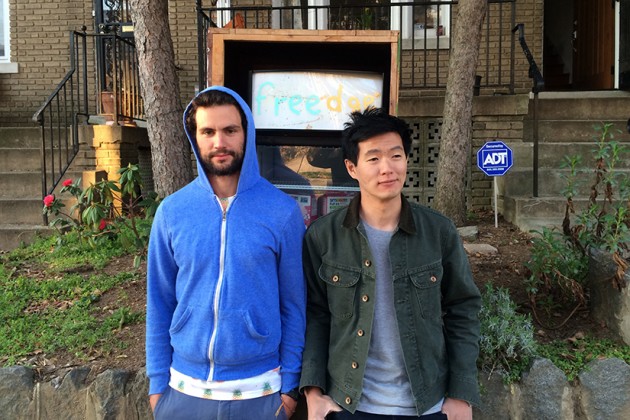
Newly Built ‘Freedge’ in Petworth Dispenses Gratis Grub to All

https://www.borderstan.com/2016/03/31/newly-built-freedge-in-petworth-dispenses-gratis-grub-to-all/

by Tim Regan — March 31, 2016 at 3:45 pm 1 Comment
There’s a running refrigerator at 1006 Quebec Pl. NW and you’re welcome to take anything you want from it.
But it’s not just a refrigerator, it’s a “freedge,” a concept that aims “to reduce food waste and build a stronger community,” said co-founder and Petworth resident Eric Yen.
Yen, who powers the freedge with an extension cord running from his house, said the idea works like a Little Free Library.
“People can take food, they can leave it, they can exchange,” Yen said. “We’re trying to reduce food waste and have people engage more with their neighbors.”
Along with co-founder Ernst Bertome, Yen built the first freedge in Davis, Calif., in 2014. The D.C. freedge is one of four across the globe, with many more planned, Yen said.
“Typically we just buy used commercial fridges,” he explained. “We got this one from an antique shop that was closing down in Maryland.”
There are two rules to stocking the freedge, according to Yen: no meat, no alcohol, but not because he’s against those items personally. Meat spoils, and distributing free alcohol is tricky, legally.
“We’ll be checking it once or twice a day whenever we go by,” said Yen. “Making sure nothing bad is in there.”
What might you find in the freedge? Canned goods, condiments, packaged goods, Yen said. But locals sometimes also drop in fresh fruit and vegetables from their gardens or even leftovers, he added.
“We’re hoping that people will be receptive to it,” Yen said. “I guess we’ll find out soon.”

Sunday, April 17, 2016

City's First Major Transgender Center Opens in The Bronx

https://www.dnainfo.com/new-york/20160415/high-bridge/citys-first-major-transgender-center-opens-bronx


 The city's first major transgender center officially opened its doors in the South Bronx on Friday afternoon.
The city's first major transgender center officially opened its doors in the South Bronx on Friday afternoon. 
View Full Caption
DNAinfo/Eddie Small
HIGHBRIDGE — Vivica Williams has been living in The Bronx for about a month and a half, and as a transgender makeup artist, she describes her situation as "not necessarily the easiest thing."
"Transphobia, discrimination, ignorance," she said, listing off the different types of challenges she has had to face. "I've had to actually personally educate people on what transgender is."
Williams, 26, is hopeful that her life will now get at least slightly easier, as the city's first major transgender center officially opened its doors on Friday afternoon in the South Bronx.
"The convenience is amazing," she said.
The center, called the Bronx Trans Collective, is located at 937 Summit Ave. in Highbridge and billed as a "one-stop center" for serving the needs of the transgender community.
It will provide visitors with services including job readiness programs, health care, housing referrals, immigration assistance and legal services, specifically regarding name changes.
The center was put together by groups including the Bronx Parent Housing Network, the Translatina Network and Community Kinship Life, where Williams volunteers.
Councilman Ritchie Torres also helped spearhead the effort, although he could not make the grand opening because of an emergency, according to his staff.
"This will transform everything, I believe," said Luisa Benedetto, Torres' chief of staff. "No longer will The Bronx transgender community have to travel to Manhattan to receive services."
Mister Cris, executive director of Community Kinship Life, acknowledged that the space was small but stressed that every group needs to start somewhere and that the building was donated, meaning they will not have to pay for rent and utilities.
Aneesha Andrews, a transgender hairstylist who lives in The Bronx and also volunteers with Community Kinship Life, said she was particularly excited to take advantage of the center's job readiness programs and maintained that it would help lead to several opportunities for the borough's transgender community.
"Everything is always in Manhattan, and it's a good feeling that it's finally in The Bronx," she said, "and we finally have a voice."

Black is the Subject: Dana Michel is Moving

http://www.artpractical.com/column/endurance-tests-black-is-the-subject/

Endurance Tests

Black is the Subject: Dana Michel is Moving

By Anna Martine WhiteheadApril 14, 2016
“Endurance Tests” is an irregular column on current explorations of representation, the ethereal, and compulsiveness by black artists working in the field of performance. Across profiles and interviews, the column takes seriously the proposition of performance as a repeatable and assimilable text. “Endurance Tests” will examine contemporary performance-makers actively syncretizing the many implications of "blackness": illegality, contagion, maladaptivity, and a privileged relationship to cool.

Montreal-based choreographer Dana Michel has requested a bit more time; our interview was postponed twice since our morning appointment. This is no problem for me. Since seeing her 75-minute deliberation on performance and spectatorship at Chicago’s On Edgefestival, I’ve been angsty as a teenage inamorata to speak with the choreographer of Yellow Towel (named a “Top Ten” dance moment in Dance Current and Time Out New York, and “engrossing” by the New York Times). Michel wants 3 p.m.? Works for me.
Yellow Towel—which positions Michel’s mumbling, munching, and contorting body within a minimalist white space—originates from her childhood practice of placing a yellow towel atop her head to attain “long, silky” locks. Rather than a narrative of abnegation and overcoming of internalized racism, however, Yellow Towel is an offering to a public that rarely gets to see the wealth of a Black body behaving so badly. Michel moves through the space performing a seemingly disjointed oeuvre of ungraceful and almost clumsy actions.  There is a general sense of shiftiness in her energy, a lack of dependability that thrives alongside an absolute clarity of movement.
Yellow Towel gifts us an alternative and orders us to watch
Consumers of Black culture (read: humans) are inundated with archetypes of the Black body: the heroic Black body, the graphically dead Black body, the righteously raging or mourning Black body. Yet it is our true bodies in all their regularity—our dysphoric, ambiguous, music-loving-but-unable-to-keep-a-beat regular-ass bodies—that we are led to believe aren’t worthy of anyone’s gaze, least of all our own. With Yellow Towel, Michel gifts us an alternative and orders us to watch.
In her review of Yellow Towel for On the Boards, African American performer Shontina Vernon writes, “I mostly was left with the question of why I needed to be present for this art to happen.”1 This guarded, curious frustration exists for good reason: Black performers have struggled to make the virtuosic Black body legible as such. As I write this, George Wolfe and Savion Glover—Glover, a czar of superlative blackness—are busy on Broadway restaging Shuffle Along, the first widely successful all-Black musical, with a few updates: At its 1921 premiere, Shuffle Along performers had to wear blackface. Since the days of obligatory dancing on the poop deck, Black performers have understood the stakes. There is a sense in all of us that we did not come this far to fail, not when we still have so much further to go.
It is an unnamed but burning desire to only see ourselves jump higher and land softer that often precludes us from bearing witness to our tumble and fall, equally glorious though they may be. So the revelation of a regularly mad Black woman becomes personal. Ultimately, Michel has created a piece that is deeply intimate to the point of unintelligibility to those who aren’t in the know, making the work powerful in the way that confidences can be, and, at times, just as disturbing, confusing, and frustrating as a secret between sisters. I asked Michel about the implications of such an intimate portrayal for such a diverse audience.2
Dana Michel. Yellow Towel (performance still); 75:00. Courtesy of the Artist. Photo: Ian Douglas. 
Dana Michel: I set up a situation that is my ideal. I appreciate having space to just look at all of someone and watch them do what they’re doing without any kind of contract to engage in any particular way. I feel such a freedom when I don’t have to worry about the moment when I’m going to try to connect with you, a stranger, through the lights and the hundreds of other people in the room. The beginning of making this work was quite shaped by my experiences as an audience member. As an audience member, I appreciate [having] a lot of space and I appreciate [falling] asleep in a performance, to go off to some other place and come back.
Also, thinking about Caribbean culture, or dancehall, for instance. When you’re in the club and you’re in the moves, the gaze is down here [Michele indicates interiority with low-lidded eyes]. The gaze is on the ground because you’re so connected to what’s going on in here [indicating her body and limbs] that you’re talking to whoever you need to talk to through your body, through the top of your head, the fucking smell of your sweat is talking to someone. It’s super powerful. I always find that when I watch dancehall or other social forms of dance that could be called “dirty dance” trying to be transformed onto the stage—all of a sudden we add this layer of looking. It destroys the nature of the beast in some way.
Anna Martine Whitehead: What do you make of the Chicago audience member’s critique, when she expressed her unease at witnessing what she interpreted as psychosis laid bare for an audience that included more white people than any other race? I read it as a discomfort with seeing Yellow Towel outside of a Black-only space—a safe space—and amongst white audiences.
DM:
 Certainly the kind of feedback that’s been happening in the States is different than anything that’s come up in the past. Maybe some things that were in the air are the things that are the most prominent here.
I guess I’d heard it. But that feeling hadn’t completely rooted until you just said it, so now I’m just processing it. I’m thinking about a piece I saw at American Realness in January, and I was maybe one of two Black people in the room. It was [Jaamil Olawale Kosoko’s] #negrophobia, and it was digging, digging, digging. And I felt super uncomfortable as one of the only Black people in the room. I’ve had that feeling maybe one other time. In that particular performance I felt like, “Why is everybody looking at me? Are they looking at me to see what my reaction is? Are they looking at me to see if it’s okay for them to feel the way that they feel?” I felt like there was a big spotlight on me because I was the Black woman sitting in the room and Black is the subject on stage. It was crazy uncomfortable.
Before this tour, there have been one to two Black people or people of color in the audience, tops. As someone who has grown up in environments where I’m one of only two or three, I’m now realizing how much that has meant that I’ve become extremely good at effacing. There’s a blending that happens. Even though you’re the only person who looks the way you look in the room, you’re trying to make it such that no one can see that.
This is part of the Utopia that I created for myself. I’m just going to put my hands deep in the guts of all the things I never allowed myself to touch. That’s the permission that I gave myself. At a certain point I was slapped in the face with the fact that I didn’t know what I was suppressing. Or I knew but I didn’t realize how much it was affecting me or how much it was affecting the shape of my life or the choices that I make.
Dana Michel. Yellow Towel (performance still); 75:00. Courtesy of the Artist. Photo: Ian Douglas. 
AMW:
  Do you feel that you are making this work for Black audiences?
DM:
 In the past it felt more like a general sharing. But performing in the States in the past month, it is the first time that I’ve seen so much variation in audience. I’ve been crying all month long during my bow. It’s been completely overwhelming. At the end of the show, when I finally look up and I see all of the diverse shades and shapes, it’s beautiful. It’s like you don’t even realize that that was missing because you’re so used to not seeing it. The possibility that there are different groups of people in the room who can relate to the work in a very different way or from a different angle than it has been in the past… I didn’t think it was possible—it wasn’t even a consideration. Then all of a sudden it is like being in a room performing with my family. It’s brought a whole new level of vulnerability.
AMW:
  Talk about your practice. Yellow Towel is the longest solo you’ve made to date.
DM:
 I used to have a very dogmatic stance of not making anything more than 5–10 minutes long—because I felt that I didn’t have anything else to say. As though everything over ten minutes long was masturbation and I refused.
I’m slow, and I accept that now. Just the other day I was pouring over [experimental theater group] Forced Entertainment’s website, and I was looking at [founder] Tim Etchells’ CV and his output. How do these people do it? He’s been popping out a piece every year since 1984.
I look at output like that and think, “This is impossible.” I’m always way too slow. I’m always the last one at the dinner table. So when I have to talk about “my body of work,” it’s like there’s suddenly a very big ocean and I have to go do a bit of scuba diving. “Oh yes, there’s this shell in 2005. I did this shell in the context of that cold current over there…” For a long time part of me didn’t understand people who say, “We’re all about the process and we don’t care about the outcome”—when I look at what I’ve been doing for the last ten years, this is actually where I place all kinds of premiums: process.
Dana Michel. Yellow Towel (performance still); 75:00. Courtesy of the Artist. Photo: Maya Fuhr.
AMW:
  Is your relationship to time at all to do with motherhood?
DM:
 I got pregnant at the same time I started to make Yellow Towel. I was seven months into the process of creating Yellow Towel when I found out I was pregnant. Having [my son] gave me more permission to sit in the relationship to time than I already had. It’s been a lifelong struggle that I’ve been tapped on the wrist for—my relationship to time. There’s the typical classic Colored People’s Time…
AMW:
  And your family is from St. Lucia, so that’s double CPT.
DM:
 It’s quadruple CPT.
AMW:
  And what you’re working on now—is it also a slowly developing process?
DM:
 It’s a continuation of Yellow Towel. It’s like I went trick-or-treating, and I came home with these huge bags and bags of Halloween candy. I didn’t even know all of this candy existed! Now I’ve taken the bags and I’ve emptied them out and I have to sort through it. That’s where I’m at. Maximalist sloth garbage. Sifting through the debris.
When I spoke about Yellow Towel before, I would first frame it as a piece about my hair. And then it became “My Black Piece,” the piece that I make where I actually get to look at the fact that I’m Black and what’s going on there. There was some kind of clear new paragraph in making Yellow Towel [from other work]. This [new work] doesn’t feel like a new paragraph—just a continuation of the last paragraph.
I was in France with my partner’s family. His cousin is an anthropologist, and she was showing us home videos of bonobos. We’re sitting in the living room and I’m the only Black person in the room. … It became something that was very fucking uncomfortable. This was a moment where I was like, “Ah, yes, I’ve just started to scratch a surface with Yellow Towel. There’s more to scratch at.”
I was speaking with the cousin and feeling… kind of weird. Similar to this woman you mentioned who felt weird to be in the audience with white people and watching [me] let this all out. I felt, also, “I’m the only Black person in the room with these monkeys. Are they looking at me and making comparisons?” I spoke with the anthropologist cousin, and she said, “Ah, you’re experiencing Freud’s uncanny thing.” Yes, for sure, but there’s also the other thing that I feel like I can’t really talk to you about. I went for a walk in the countryside, and new thoughts of the new work began to formulate.
AMW:
  It’s a very intuitive process with you, it seems, which works cerebrally as much as deep in your gut.
DM:
 I still feel—and maybe will feel for the rest of my life—like an outsider, a newcomer. Art came to me so late in the development of myself as a human. I was 25 the first time I really started looking at art and performance. It was not a part of how I was raised, or what any of my friends were into, or my schooling.
I was in business school and started dating someone, and he brought me to my first rave. It cracked open a new space—it was like, “Oh, there’s another place! I thought I had to become an accountant!” There’s been similar micro-moments over the years. Happening upon an Aphex Twin video and thinking, “What is that?” A friend of mine had free tickets to a contemporary dance show, and I went to see this company from Montreal. I didn’t know what I was looking at or what was going on, but I loved this experience of sitting by myself in this theater not knowing what the fuck was going on. It was a wonderful feeling.
I think it stems from my relationship to time and how long it takes me to eat a crumb. It’s been fifteen years and I still feel really very naïve. I digest slowly, but all the nutrients are there.
Dana Michel. Yellow Towel (performance still); 75:00. Courtesy of the Artist. Photo: Maxyme G. Delisle.
AMW:
  When did you begin your formal training?
DM:
 I was at my job one day and saw an ad in a newspaper for a contemporary dance [degree]. I called [the university] randomly. The director said, “Yes, come for an audition!” A year later I auditioned, and not long after that I was going to dance school. I was out of school for six years before I did danceWEB.3
Eventually I had a nervous breakdown trying to be a “normal” person. I was working in a hospital job for ten years and I vowed I’d never leave it because it was so practical and it allowed me to keep a foot in the “real” world. I took a leave of absence and a friend said, “Since you’re taking a year off, why don’t you apply for this danceWEB thing?” Which, to me, was for intense professional people and I had no business doing that kind of thing.4
AMW:
  And now? How does it feel now to have no feet left in that “real” world?
DM:
 It’s a constant adjustment. It’s changing week by week and day by day. It’s a huge process to have been raised a certain way and having that shape your thinking, and then to be making up all kinds of new rules and digging the road as you’re trying to walk in it. You’re not quite sure you have the right. And then also, I have a child who’s fresh on the scene.
Very recently, I have been feeling: “That’s enough of saying, ‘Thank you very much, this is going very well right now, I don’t know how much longer this is going to last, maybe next year this will be over.’” The constant I-don’t-know-what’s-happening. I’m trying to let myself be fully in this situation. Whatever way things need to evolve, they will, and I don’t need the intense guilt around things going quite well.
Last week I was in a hotel, up until six in the morning, writing and thinking about things that I wanted to do or dig into. I often think, “Well, this is it, I have nothing else to say, so I’m not going to last much longer. The jig is up and people are going to know any day now. I’m a one-hit-wonder.” But maybe it’s okay to think about what else I might want to do. It feels crazy. It’s a crazy, beautiful, amazing gift to spend all my time doing this thing. Having wonderful conversations that are helping me to evolve and sweat a little.
I am quite lucky. I have people who love me and want to support me. So rather than wasting a bunch of energy and guilt, maybe I can just reinvest that energy into the opportunity that’s being given to me.
________
This article is made possible through our Writers Fund, thanks to readers like you. Help us keep it going!