Monday, March 26, 2018

The Parkland kids keep checking their privilege

https://edition.cnn.com/2018/03/24/politics/march-for-our-lives-students-checking-privilege-trnd/index.html


Washington (CNN)Ahead of the March for our Lives rally, Marjory Stoneman Douglas High School student David Hogg said the media's biggest mistake while covering the school's shooting was "not giving black students a voice."
"My school is about 25 percent black, but the way we're covered doesn't reflect that." Hogg said during an Axios event Friday.
Hogg, one of the core members of the #NeverAgain Movement, hasn't shied away from acknowledging his privilege. In fact, "privilege" came up in many of the speeches at Saturday's march in Washington, D.C.
    While taking the stage again -- this time before hundreds of thousands -- Hogg and other students made sure to include victims of gun violence from across other communities.

    'We share this stage'

    "We recognize that Parkland received more attention because of its affluence," Jaclyn Corin, a survivor of the Parkland shooting, said during her speech. "But we share this stage today and forever with those communities who have always stared down the barrel of a gun." 
    Corin brought Yolanda Renee King, Martin Luther King Jr.'s granddaughter, to the stage as her special surprise guest. 
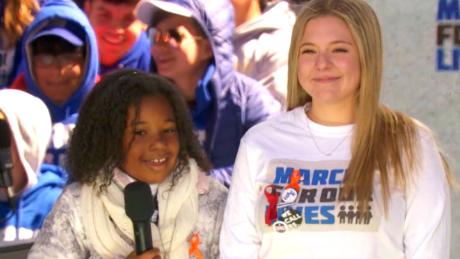
    MLK Jr.'s granddaughter surprises rally crowd 02:11

    'It's not about race'

    Alex Wind, another Parkland shooting survivor, addressed how gun violence affects everyone in the US.
    "It's not about race. It is not about your sex. It is not about ethnicity. It is not about gender. It is not about how much money you make," he said during his speech. "What it comes down to is life or death."
    Aalayah Eastmond, another Parkland shooting survivor, spoke about how gun violence isn't something new, and must not be overlooked in urban communities.
    "Yes I am a Parkland survivor and an MSD student," she said. "But before this i was a regular black girl and after this I am still black and I am still regular, and I will fight for all of us."

    'I represent African-American women'

    Non-Marjory Stoneman Douglas High School students also used their speeches to echo this point.
    Naomi Wadler, an elementary student from Virginia, said she was speaking on behalf of all of the "African-American girls whose stories don't make the front page of every national newspaper."
    "I represent the African-American women who are victims of gun violence," she said. "Who are simply statistics instead of vibrant beautiful girls full of potential."
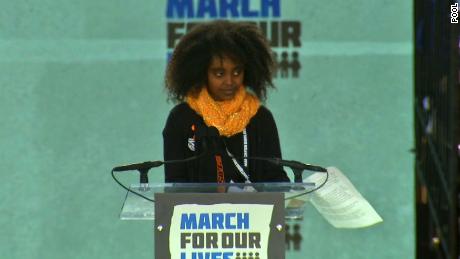
    11-year-old: Never again for black girls too 01:02
    The 11-year-old continued: "I'm here to acknowledge their stories. To say they matter. To say their names. Because I can. And I was asked to be. For far too long, these names, these black girls and women, have been just numbers. I'm here to say never again for those girls too."
    Many on Twitter noticed -- and praised -- the Parkland students for sharing their moment in the spotlight with people of color.
    Added another Twitter user: "So glad to see all these black and brown kids given an opportunity to speak up too! Much respect to the Parkland students for using their privilege to give others space to speak and get some spotlight. #Hope #BlackLivesMatter #MarchForOurLives #VoteThemOut2018."

    Thursday, March 15, 2018

    If I Die

    October 11th, 1988:   Photo taken by Bill Dobbs during the height of the HIV/AIDS epidemic.
    David Wojnarowicz' at ACT UP’s FDA Action protest .

    March 14th 2018 US Students organize school walk outs across the country against gun violence

    Tuesday, August 15, 2017

    Confederate monument in Baltimore drenched with red paint

    Someone poured red paint over a Confederate monument in Bolton Hill, defacing the 114-year-old statue during a weekend in which violence erupted at a white nationalist rally in Charlottesville, Va.
    Baltimore police had not received reports of the vandalism, a spokesman said Monday afternoon. But red paint had drenched the statue of a dying Confederate soldier embraced by a winged figure of Glory. The soldier grips a Confederate battle flag, also smeared with red paint.
    More than 1,000 people marched through Baltimore Sunday in opposition to the violence and racism at the Virginia rally. The white nationalist rally turned deadly after a man rammed his car into a crowd of counter protesters, killing 32-year-old Heather Heyer. Police charged the alleged driver, James Fields Jr., 20, in the killing.
    The violence reignited debate over Confederate monuments in Maryland. Mayor Catherine Pugh said she has reached out to two contractors about removing the rebel monuments in Baltimore. House Speaker Michael E. Busch said it’s time to remove from the lawn of the Maryland State House the statue of former U.S. Supreme Court Justice Roger B. Taney, who wrote the infamous 1857 Dred Scott decision that upheld slavery and denied citizenship to black people.
    The confederate statue vandalized with red paint was erected by the state chapter of the Daughters of the Confederacy in February 1903. The inscription reads “Gloria Victis,” meaning “glory to the vanquished.”
    The monument stands on Mount Royal Avenue near Mosher Street.
    In 2015, after a white man killed nine black church members in South Carolina, the monument was tagged with “Black Lives Matter” in yellow spray paint. 

    Protesters pull down Confederate statue at old Durham County courthouse

    http://wncn.com/2017/08/14/protesters-rally-against-confederate-monument-in-front-old-durham-county-courthouse/

    DURHAM, N.C. (WNCN) – A crowd of protesters gathered outside the old Durham County courthouse on Main Street Monday evening in opposition to a Confederate monument in front of the government building.
    CLICK TO VIEW 14 LARGER PHOTOS OF THE TOPPLING
    Around 7:10 p.m. a woman using a ladder climbed the statue of a Confederate soldier and attached a rope around the statue.
    Moments later, the crowd pulled on the rope and the statue fell.  One man quickly ran up and spat on the statue and several others began kicking it.
    Durham police later said they monitored the protests to make sure they were “safe” but did not interfere with the statue toppling because it happened on county property.
    “Because this incident occurred on county property, where county law enforcement officials were staffed, no arrests were made by DPD officers,” Durham Police spokesman Wil Glenn said in a statement.
    Durham County Sheriff’s deputies videotaped the statue being brought down — but didn’t stop it from happening.
    After toppling the statue, the protesters started marching. They blocked traffic with authorities trying to stay ahead of them. The protesters made their way down East Main Street to the site of the new Durham Police Department.
    In 1924, the Confederate statue was dedicated to Durham.
    Engraved on the front of the monument is “The Confederate States of America.”
    Above it, was the statue representing a soldier who fought in the civil war.
    “Today we got a small taste of justice,” protester Jose Ramos said after the statue was down.
    Later Monday night, North Carolina Governor Roy Cooper Tweeted: “The racism and deadly violence in Charlottesville is unacceptable but there is a better way to remove these monuments.”
    After the Durham statue fell, several dozen protesters congregated on the street in front of the old courthouse. Some took pictures standing or sitting on the toppled soldier, in front of a pedestal inscribed with the words “In Memory of the Boys Who Wore The Gray.”
    “It needs to be removed,” Loan Tran, an organizer, said earlier Monday. “These Confederate statues in Durham, in North Carolina, all across the country.”
    There are similar monuments in several cities around North Carolina.
    news-app-download-apple-350x50news-app-download-android-350x50
    Tran doesn’t want to see it anymore.
    “When I see a Confederate statue in downtown Durham, or really anywhere, it fills me with a lot of rage and frustration,” she said.
    Organizers say Monday’s protest was a reaction to the events in Charlottesville this past weekend.
    “People can be mobilized and people are angry and when enough people are angry, we don’t have to look to politicians to sit around in air conditions and do nothing when we can do things ourselves,” said Takiyah Thompson, a protester.
    In an email to CBS North Carolina, Durham County spokeswoman Dawn Dudley says:
    “Due to a North Carolina state law passed a few years ago, Durham County is prohibited from removing or making substantive alteration to historical monuments and memorials. I share this to say that there is a statute in place making the efforts you mention below difficult to move forward. I would assume that the only thing possible are steps to reverse the law.”
    This statue has been the center of controversy before after graffiti was spray painted on it a few years ago.
    The group that met Monday say their purpose is to “smash white supremacy.”


    — The Associated Press contributed to this report

    Monday, August 14, 2017

    After Twitter Refused To Delete Homophobic, Racist Tweets, An Activist Spray Painted Them Outside The Company’s Office

    http://www.newnownext.com/twitter-graffitti-hate-speech/08/2017/?fb_ref=fbshare_web

    "If Twitter forces me to see those things, then they’ll have to see them too."
    After Twitter refused to delete hundreds of abusive tweets, a German activist spray painted them all over the pavement outside the company’s offices in Hamburg.
    Shahak Shapira, who is of German-Israeli descent, says he’s reported nearly 450 homophobic, racist, anti-Semitic, and sexist posts to Twitter and Facebook over the last six months. A majority of the approximately 150 Facebook posts were removed within three days, but, of the more than than 300 abusive tweets he reported, he received responses to only nine. And each one stated that there’d been no violation of Twitter’s rules. 
    The posts included tweets like “Lets gas some Jews together” and “hang these lowlifes from the nearest street post,” as well as calls for violence against Muslims, gays, women and people of color. 
    “[They] weren’t just plain insults or jokes,” Shapira explains, “but absolutely serious threats of violence. Homophobia, xenophobia, Holocaust denial. Things no one should say and no one should read.”
    He decided the best way to draw attention to the issue was to take the hate speech off the web and put in the street where everyone—including Twitter—would have to look at it. “I thought, okay, if Twitter forces me to see those things, then they’ll have to see them, too.”
    Shapira made large stencils out of 30 reported tweets, then he and several friends used temporary, chalk-based spray paint to cover the sidewalk, stairs and street in front of Twitter’s office building. The next morning several passersby complimented Shapira on his efforts.
    “It angers me that most people don’t revolt against this,” one man said. “They just accept it. I think that’s fucked up.”
    Another pointed out that it’s a bad look for Twitter to leave abusive tweets in place: “It’s careless to let this happen to your own product. It shouldn’t happen.”
    Shapira is working to spread that message using the hashtag #HeyTwitter. “This will never be big enough to visualize the amount of hate tweets on Twitter,” he says, “but maybe we can at least give them some food for though.”
    Learn more about his project in the video below.


    I believe that true, well-told stories have the power to change the world for good. I also love a good listicle.
    @KristinaSaurusR

    Friday, June 9, 2017

    LGBTQ Refugee Rights Group Steals Artwork from Documenta in Athens

    https://hyperallergic.com/382407/lgbtq-refugee-rights-group-steals-artwork-from-documenta-in-athens/?utm_source=email&utm_medium=social&utm_campaign=sw


    "In an act of protest against the German quinquennial, the group Lgbtqi+ Refugees in Greece has rock-napped Roger Bernat’s sculptural replica of an ancient monolith.
    An LGBTQI refugee rights group in Athens has stolen an artwork from Documenta 14 to protest what they perceive as the German quinquennial’s exploitation of refugees seeking asylum in Greece. On May 21, the grassroots organization Lgbtqi+ Refugees in Greece carried off artist Roger Bernat‘s 110-pound, plastic and fiberglass replica of an ancient Greek monolith known as the oath stone, upon which council members once swore their vows. The theft was executed during a theatrical performance to walk the stone around Athens before its transportation to Documenta 14’s other host city, Kassel, by plane. There, Bernat intended to bury it as part “The Place of the Thing,” his collaboration with dramatist Roberto Fratini that considers a Nazi-pioneered form of mass theater. The Spanish artist had invited various collectives and groups in Athens to help tour the stone over the course of one week to locations including museums, public schools, embassies, homes, and bars.
    But Bernat’s stone never made it to Kassel, as the individuals he had paid to carry it that Sunday turned out to be protestors who took issue with the project’s underlying spending of resources. Lgbtqi+ Refugees in Greece, who accepted €500 (~$560) to participate in the piece, seized the stone midway through an event at Athens’s Polytechnic University. The group then issued a statement saying that it condemns “the ‘fetishization’ of refugees and disparages the use of vast resources on the high-profile arts event, while the hundreds of thousands of refugees languish invisibly in Greece and across Europe.” Members dubbed their brazen act, “Between a rock and a hard place,” and christened it with a counter-title to the festival: “Rockumenta 14.” They added that they have no intention of returning Bernat’s stone.
    “You have come to Greece to make art visible, graciously offering to purchase the participation of invisible exoticized ‘Others,’” the group wrote. “Your stone is supposed to give us a voice, to speak to our stories. But rocks can’t talk! We can! So we have stolen your stone and we will not give it back. And like the millions of others who are seeking better lives in Europe, your stone has disappeared.” The statement then offers tongue-in-cheek possibilities of where the artwork could be, each one highlighting the challenges asylum seekers face, from the bureaucratic to the humanitarian: the rock might be in a distant prison, languishing without papers; at the bottom of the Mediterranean; on a flight to Sweden, equipped with a fake passport; in a detention center, contemplating suicide.
    Clearly angered by the heist, Bernat and Fratini published a 13-point rebuttalon Bernat’s website to denounce the act as a publicity stunt. The pair’s statement emphasized that they never asked anything of the collective, to whom they essentially surrendered the stone for the purpose of the performance.
    “This project, thought as a deconstruction of the notion of Thingspiel, is about seeing which kind of cultural meaning, political value or even religious charisma can acquire for different collectives and individuals an archeological piece,” they wrote. “And to see how individuals and collectives can negotiate the absolute pretext the object represents.”
    Their statement also clarified the financial decisions behind the performance. “The collective was never ‘purchased,” Bernat and Fratini wrote. “Having a budget for the project, we simply decided to share the money between all the associations and collective that willingly declared themselves interested in doing something with the stone. If we hadn’t offered any money, we would have felt that we were luring people into sharing the project for nothing.”
    The artists said they can afford to lose the stone, having already created two copies of the original, apparently in anticipation of a theft. But the collective’s gesture, aside from introducing some hilarity to the typically austere German festival, amplifies frustrations felt by many over its arrival in a country facing economic, political, and social turmoil."


    Tuesday, May 2, 2017

    Art can’t do anything if we don’t.

    From:
    http://www.artpractical.com/issue/art-cant-do-anything-if-we-dont/


    Julio Salgado Mural

    Introduction

    For our first issue of 2017, we asked eight contributors: what can art do in times of social and political turmoil? This line of inquiry seemed undeniable – rearing its head in the poignant essays in our last issue Art + Citizenship, the driving force behind post-election actions across the country, and at the center of how we as an arts publishing organization were evaluating our own efficacy as an arts publishing organization.
    We sought out a range of voices whose vocations include: art critic, curator, professor, radical organizer, visual artist. The responses we received surprised us.  Taken together, these essays shake up the very framework of the issue as we laid it out, breaking up our well-groomed inquiry into a complex cluster of meaning. Too, there is a distinct personal tenor to the narratives in this issue, one we don’t often see in arts writing. I take this as a sign that those of us that teach, advocate, institutionalize, or historicize art should be asking ourselves the same question. Art can do a lot of things, but the real question seems to be: what can we do? Art is just one of many areas under serious threat in our current landscape. Looking to radical visionaries that came before us and those that walk among us now, many of our writers summon an incredible invocation of the future through their writing. Art can help us see differently, to imagine better realities. It’s time to put our imaginations to work, or we risk being implicated in fortifying the same systems we hope to crumble. Look to art. Act swiftly. As Vivian Sming notes in her essay, “Art can’t do anything if we don’t.”—Kara Q. Smith