Thursday, April 5, 2018

120 Beats per Minute


LGBT people need to rediscover their rage in this age of protest

As the film 120 Beats per Minute shows, queer activism is at its best when it’s angry and combative – and there’s no shortage of causes to help
A scene from 120 Beats per Minute
 A scene from 120 Beats per Minute. ‘The film proposes homosexuality as a vibrant and questioning counterpoint to polite society.’ Photograph: Allstar/Memento Films
When director Robin Campillo won the prize for best film last month at France’s César awards, he used the opportunity to plead for the rights of French sex workers, drug users and migrants. The star of 120 Beats per Minute, Nahuel Pérez Biscayart, upon winning a César for most promising actor, spoke out on the subject of abortion rights in his home country of Argentina. This is all to say that the film, released in the UK last week, has politics coursing through its veins. In a time of great political division, its clarion call for protest and its questions about queer identity are perhaps more urgent than ever.
The film tells the story of a group of Parisian activists in the 1990s who form the French arm of the protest group ACT UP. Consisting of HIV and Aidssufferers and assorted queer folk, the collective takes radical action to remind society of the savage Aids epidemic that predominantly affected gay men, and to campaign for better laws and access to medication. The film underlines divisions between group members who are unsure about whether to be more radically queer and in-yer-face, or whether that belligerence undermines their efforts for recognition. What is unmistakable, however, is a vigour and excitement about the idea of protesting: there is a nostalgia for the concept of marching together, for the camaraderie of hatching plans. The film proposes homosexuality as a vibrant and questioning counterpoint to polite society; its protagonists are young, aware and angry. It could not be more burningly topical.
Emma Gonzalez (centre), a survivor of the school shooting at Marjory Stoneman Douglas High School, cheers at the conclusion of the March For Our Lives in Washington, DC.
Pinterest
 Emma Gonzalez (centre), a survivor of the school shooting at Marjory Stoneman Douglas High School, at the March For Our Lives protest in Washington, DC. Photograph: Jim Lo Scalzo/EPA
In late March, a young woman stood up in Washington DC and called out the names of her peers who had died in a school shooting, before descending into a long and powerful silence, as she stood at the lectern for the amount of time that it had taken for her classmates to be gunned down. Emma Gonzalez, the bisexual Cuban-American woman spearheading the March For Our Lives movement, has talked about the way her LGBTQ activism and her work against gun violence are related: it seems clear that her outsiderness is key to her stance. In being outspoken, Gonzalez has been attacked by Republicans such as Steve King, a congressman with a history of making homophobic statements.
Members of ACT UP and Gays Against Guns could also be found protesting at the anti-gun marches in the US. Today’s generation of young people demanding change, including Black Lives Matter protesters fighting state violence, is of a piece with 120 Beats per Minute’s activists – right down to their witty, irreverent responses to the establishment. The film’s generational clash between out gay activists and a homophobic society finds an easy parallel in a dispossessed generation of millennials fighting ideological battles today.
Equally, the film asks where queer people can go next. It comes at a time when queer cinema has become less niche and less confrontational: from God’s Own Country to Call Me By Your Name, to Love, Simon, the new gay theme is one of acceptance of homosexual people by their straight families. Coupled with the return of the appalling minstrelsy of Queer Eye, we are seeing a more emollient culture, one aimed at happy and accepted gay people who are sick of anguished depictions of suffering victims. But we need to rekindle some of our abrasiveness. 120 Beats per Minute doesn’t plead for heterosexual patronage, because straightness is not a part of that world. Its register, while combative, is joyous and celebratory, giving us something with fire in its belly, and which calls for queers to rediscover our radicalism and fight not for integration so much as acceptance of our difference.
There is still much to fight for. We have a Tory government riddled with homophobia, outing a young whistleblower in a statement sanctioned by Downing Street, and forming a coalition deal with the Democratic Unionist party. From Andrea Leadsom and Jacob Rees-Mogg flaunting their opposition to equal marriage to David Davies expressing transphobic views, the ruling party isn’t often shy about its disregard for the queer community.
Taking a page from 120 Beats per Minute’s generosity of spirit and universalism, all queers should make a point of standing with our trans siblings, attacked every day in our streets and press, and the Muslim community, often the object of ignorant vilification in our name. Access to the HIV medication PrEP should be made readily available on the NHS. Queer people are over-represented among Britain’s growing homeless population. And that’s just in Britain; the rest of the world deserves our attention too.
120 Beats per Minute posits queerness as open and generous – turning outwards rather than in on itself, to other marginalised communities, in empathy, solidarity and riotous communion. The righteous outrage it displays, and its passionate call to arms, will always be salutary to the LGBTQ movement, and always topical.
 Caspar Salmon is a film writer based in London

Monday, March 26, 2018

Emma Gonzalez, March for Our Lives

PHOTO: NICHOLAS KAMM/AFP/GETTY IMAGES. 
Emma González has been an incomparable voice in the fight against gun violence. Her righteous anger is only matched by her ability to make us feel her deep grief. Despite facing homophobia and the gun lobby, she tirelessly organized around this issue and now has the attention of a nation. When she speaks, we listen, and she amplifies voices that cannot speak out.Today, she spoke at the March For Our Lives in Washington D.C. Her speech was chilling, and you will not be able to stop thinking about it after you see the video. We shouldn’t stop thinking about this issue. Lives are literally at stake, and her speech carried that weight.
“Six minutes and 20 seconds,” she began. That was how long it took for 17 of her classmates and teachers to be killed at Marjory Stoneman Douglas High School. It only took six minutes because the shooter used an AR-15 assault rifle, a firearm created with the expressed purpose to kill as many people as possible in a short amount of time. Gonzalez intoned the names of those who were laid to rest, her voice cracking with anguish. “My friend Carmen will never complain to me about piano practice,” she said. The names continued, until suddenly Gonzalez stopped speaking.
She sat in silence. Tears began streaming down her face, but she stood resolute. The crowd occasionally erupted with chants of “never again!” and applause; the camera showed us the faces of marchers who also cried during González’s silence. It was a painfully poignant moment, the likes of which we’ll remember in the years to come.
Finally, she began speaking again. “Since the time that I came out here, it has been six minutes and 20 seconds,” she said. That’s all the time it took for 17 people to lose their lives. Gonzelez wrapped up her speech by pleading for all us to “fight for your life. Before it’s someone else’s job.” She walked off stage to thunderous cheers.
You can watch the video below.

Call and Response by Yolanda Renee King, Martin Luther King Jr.'s granddaughter

http://time.com/5214244/yolanda-renee-king-martin-luther-king-march-for-our-lives/

During the March for Our Lives Rally (March 24, 2018)

“Will you please repeat these words after me?” Yolanda asked the crowd. “Spread the word, have you heard? All across the nation we are going to be a great generation.”

The Parkland kids keep checking their privilege

https://edition.cnn.com/2018/03/24/politics/march-for-our-lives-students-checking-privilege-trnd/index.html


Washington (CNN)Ahead of the March for our Lives rally, Marjory Stoneman Douglas High School student David Hogg said the media's biggest mistake while covering the school's shooting was "not giving black students a voice."
"My school is about 25 percent black, but the way we're covered doesn't reflect that." Hogg said during an Axios event Friday.
Hogg, one of the core members of the #NeverAgain Movement, hasn't shied away from acknowledging his privilege. In fact, "privilege" came up in many of the speeches at Saturday's march in Washington, D.C.
    While taking the stage again -- this time before hundreds of thousands -- Hogg and other students made sure to include victims of gun violence from across other communities.

    'We share this stage'

    "We recognize that Parkland received more attention because of its affluence," Jaclyn Corin, a survivor of the Parkland shooting, said during her speech. "But we share this stage today and forever with those communities who have always stared down the barrel of a gun." 
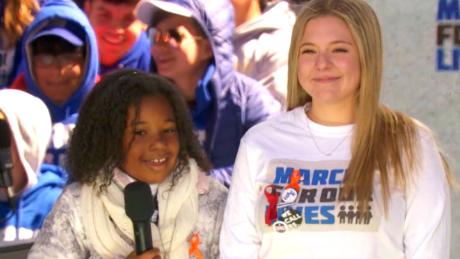
    Corin brought Yolanda Renee King, Martin Luther King Jr.'s granddaughter, to the stage as her special surprise guest. 
    MLK Jr.'s granddaughter surprises rally crowd 02:11

    'It's not about race'

    Alex Wind, another Parkland shooting survivor, addressed how gun violence affects everyone in the US.
    "It's not about race. It is not about your sex. It is not about ethnicity. It is not about gender. It is not about how much money you make," he said during his speech. "What it comes down to is life or death."
    Aalayah Eastmond, another Parkland shooting survivor, spoke about how gun violence isn't something new, and must not be overlooked in urban communities.
    "Yes I am a Parkland survivor and an MSD student," she said. "But before this i was a regular black girl and after this I am still black and I am still regular, and I will fight for all of us."

    'I represent African-American women'

    Non-Marjory Stoneman Douglas High School students also used their speeches to echo this point.
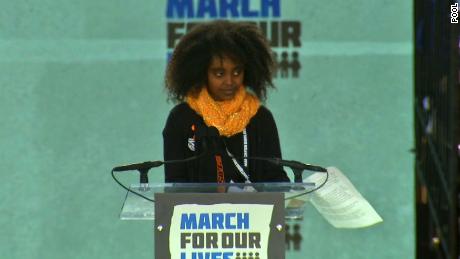
    Naomi Wadler, an elementary student from Virginia, said she was speaking on behalf of all of the "African-American girls whose stories don't make the front page of every national newspaper."
    "I represent the African-American women who are victims of gun violence," she said. "Who are simply statistics instead of vibrant beautiful girls full of potential."
    11-year-old: Never again for black girls too 01:02
    The 11-year-old continued: "I'm here to acknowledge their stories. To say they matter. To say their names. Because I can. And I was asked to be. For far too long, these names, these black girls and women, have been just numbers. I'm here to say never again for those girls too."
    Many on Twitter noticed -- and praised -- the Parkland students for sharing their moment in the spotlight with people of color.
    Added another Twitter user: "So glad to see all these black and brown kids given an opportunity to speak up too! Much respect to the Parkland students for using their privilege to give others space to speak and get some spotlight. #Hope #BlackLivesMatter #MarchForOurLives #VoteThemOut2018."